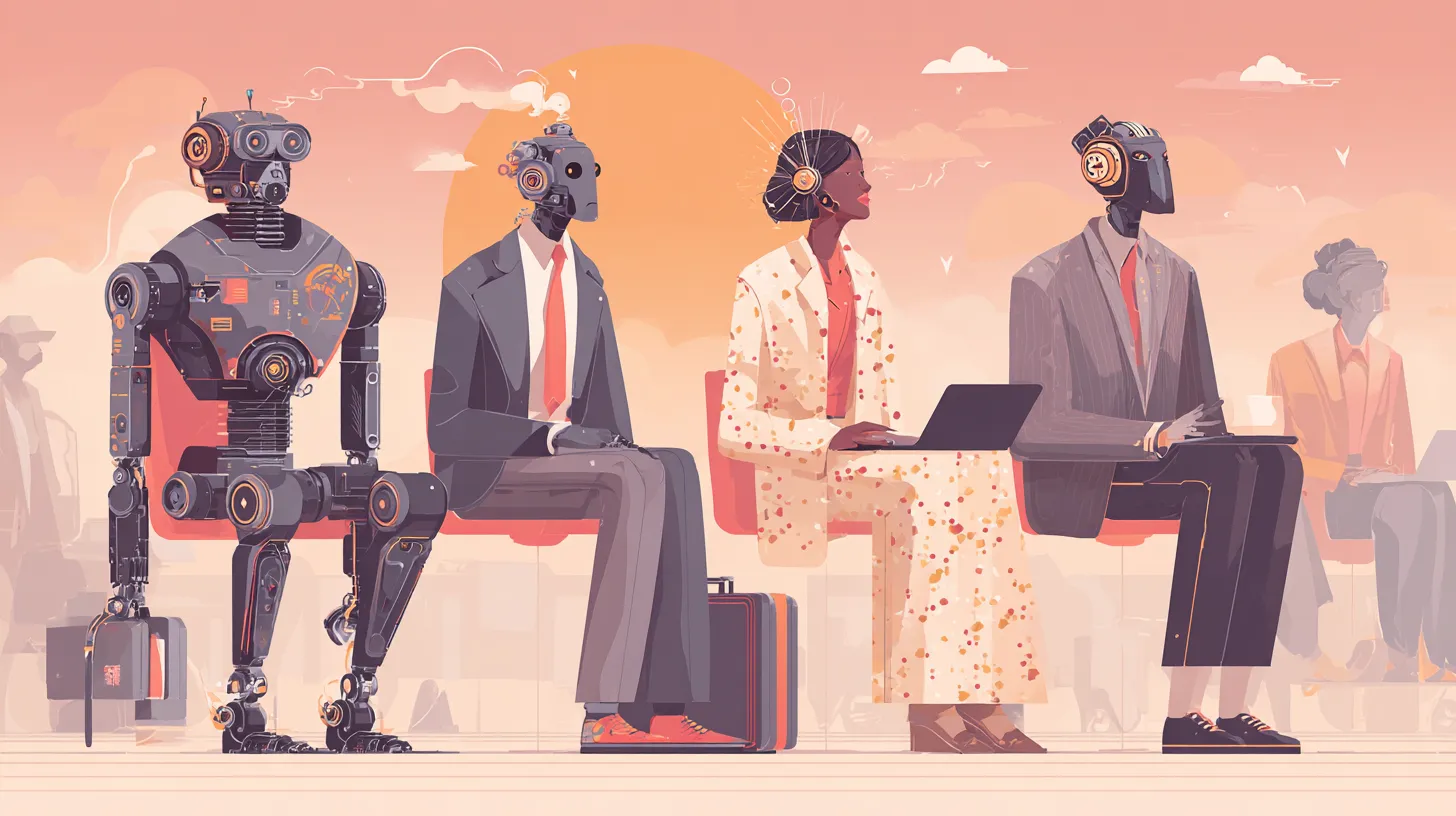
Large companies around the world are building AI into their core operations. This is changing their workforces in big and varied ways. Some jobs are replaced directly, organisations are restructured, and the way companies hire changes at a basic level. The main drivers are higher productivity, large cost savings and a competitive edge in a global economy that runs more and more on AI.
The growing role of AI in company strategy
AI is no longer just a helper tool. It is now central to operations and HR strategy, and it shapes hiring decisions at the most basic level. The shift comes from what AI can do. It automates repetitive tasks, greatly improves human decision-making and opens new paths for growth and innovation.
The main drivers of AI-driven workforce change:
- Efficiency and productivity: Bringing in AI gives big gains in operational efficiency and overall productivity. Companies use AI to streamline complex operations and automate routine tasks. For example, Aberdeen City Council in Scotland projected a 241% return on investment from Microsoft 365 Copilot. That is about $3 million a year in time saved and higher productivity, according to Microsoft’s case study. Klarna said AI cut its marketing costs by $10 million a year. Of this, $6 million came from cheaper image production and about $4 million from spending less on agencies.
- Lower costs: The chance of large savings, especially in labour-heavy roles, is a strong reason to replace human workers with AI. IBM, for example, has automated many HR tasks. Shopify, with its “AI before hiring” rule, also aims to keep operating costs down. Chegg, an education technology company, faces strong competition from AI tools. In May 2025 it planned a restructuring to save $100–110 million a year in 2026.
- Strategy and competitive edge: Beyond quick efficiency gains, companies adopt “AI-first” strategies to stay competitive, speed up innovation and scale more easily. Cisco and Intuit linked job cuts to reinvesting in AI, which shows resources moving into high-growth areas that matter for future market leadership.
- Labour shortages and hard tasks: In some sectors, such as manufacturing and logistics, AI and robots help with a lasting shortage of skilled workers. They can also take over tasks that are physically hard, unsafe or monotonous.
How big the expected change is
The expected impact of AI on the world’s workforce is large. Goldman Sachs estimated in 2023 that generative AI could expose the equivalent of 300 million full-time jobs to automation worldwide. The World Economic Forum (WEF) has published several forecasts. In 2020 it expected machines and algorithms to displace 85 million jobs by 2025 and create 97 million new ones. Its Future of Jobs Report 2025 says 86% of employers expect AI and information processing to transform their business by 2030. Across all the trends it studies, the WEF expects 170 million new jobs and 92 million lost by 2030.
Company examples: AI-driven workforce restructuring
Bringing in AI is making large companies in many industries rethink and rebuild their workforces. Here are some telling examples:
- Klarna: The Swedish fintech giant Klarna, known for “buy now, pay later”, shows how complex AI’s role in customer service is. In 2024 the company said its AI assistant, built with OpenAI, did the work of 700 full-time agents. It stopped hiring people for these roles. Klarna estimated it would bring a $40 million profit improvement in 2024. But the aggressive automation strategy left customers unhappy: they felt it lacked empathy, and the AI couldn’t solve complex problems. In May 2025 Klarna said it would hire human support staff again. It planned a flexible, remote model to bring back the human touch, especially for more delicate conversations. Klarna is not alone in having doubts. A 2025 Orgvue survey asked senior leaders about this. Of those who had made staff redundant because of AI, 55% said they regretted it.
- UPS (United Parcel Service): In logistics, UPS announced big job cuts. It planned to cut 20,000 jobs in 2025 and close 73 buildings. The company linked this mainly to a planned cut in the Amazon parcels it handles. But automation is part of the plan too: about 400 of its facilities are being partly or fully automated. UPS uses advanced robotics and AI for route planning, real-time monitoring and predictive maintenance. By October 2025 it had cut about 48,000 jobs, well above the original 20,000.
- Duolingo: The language-learning platform Duolingo follows an “AI-first” strategy. This includes gradually phasing out contractors for work AI can do. In January 2024 the company cut about 10% of its contractors, citing AI for content creation and translation. The CEO later said no full-time staff were laid off.
- Microsoft: The tech giant Microsoft also restructured heavily while spending more on AI. It announced about 6,000 job cuts in May 2025, then another 305 in June 2025. About 9,000 more followed in July 2025. The cuts were part of a wider plan to remove layers of management and focus on engineering talent. The company is also moving money into AI development, rollout and data centres.
- IBM: IBM used AI to take over work once done by a couple of hundred HR staff. Its AI system “AskHR” now handles about 94% of routine HR tasks, such as holiday requests and payroll documents. At the same time, CEO Arvind Krishna said IBM’s total headcount went up, as it hired more programmers and salespeople.
- Cisco: The networking giant Cisco announced a 7% cut in its workforce in August 2024, its second round that year. It wanted to invest more in AI and cybersecurity.
- Citigroup: In finance, Citigroup was in the middle of a large global restructuring in 2025. In June 2025 it said it would cut about 3,500 tech jobs in China, at its centres in Shanghai and Dalian, during 2025. The bank did not present these cuts as AI-driven, which shows that not every big cut is about AI.
- Shopify: The e-commerce platform Shopify adopted a radical “AI before hiring” rule. In an April 2025 memo, CEO Tobi Lütke said teams must show why AI can’t do the job before asking for more people.
- Chegg: The education technology company Chegg shows AI’s indirect effect on jobs. In May 2025 Chegg cut 22% of its workforce (248 people) and closed its offices in the US and Canada. This was less about Chegg’s own AI replacing workers. It was more a reaction to fierce competition from free or cheaper AI tools such as ChatGPT, AI Overviews and Gemini. In October 2025 Chegg cut about 45% of its remaining staff.
By sector: where AI shows up
AI’s effect on jobs depends on the type of work, the technology already in place and the needs of each industry.
- Technology: This sector is at the centre of AI development and adoption. That brings big internal disruption, even as it drives AI innovation worldwide. Jobs such as software engineering are directly affected. Some are replaced by AI coding tools, or their roles are heavily restructured.
- Customer service: This sector has proved very open to automation with AI chatbots and virtual agents. Customer service agents, call centre staff and support representatives are directly affected.
- Finance and banking: The finance and banking industry is seeing a lot of automation of routine tasks, data analysis and back-office work.
- Manufacturing and logistics: These industries are automating more on factory floors and across the supply chain. UPS is a key example: automation affects warehouse and sorting centre staff, and potentially delivery drivers.
- Education technology (EdTech): AI affects the EdTech sector in content creation and teaching, and can also disrupt business models. Duolingo reduced its reliance on contractors for content creation and translation by using generative AI for these tasks.
The human factor: dealing with job losses and change
The fast arrival of AI in company operations has serious human consequences.
- Different effects on different roles: AI has the biggest effect on entry-level roles. These roles, common in tech and many white-collar jobs, often involve routine, predictable tasks that are easy to automate. Dario Amodei, head of Anthropic, warned in May 2025 that AI could wipe out half of entry-level white-collar jobs within one to five years.
- Experienced roles change too: Experienced professionals are not safe from AI either. Software engineering jobs at Microsoft and various management positions are also being restructured.
- How companies support affected staff: Many companies offer support to affected employees, although the size and quality of these programmes vary. They include severance pay, retraining and upskilling, help finding a new job, and moves to other roles within the company.
- A shift in the skills needed: As AI replaces some jobs, demand grows for a new set of skills. These include AI literacy, adaptability and continuous learning, and higher-order thinking skills (critical thinking, creativity, complex problem-solving, emotional intelligence). Technical skills matter too (AI development, data analysis, cybersecurity).
- Psychological impact: Fast AI adoption and the layoffs that come with it hit people hard psychologically, though this is hard to measure. In 2024, Cisco employees described low morale and a lot of anxiety in anonymous accounts, as they waited to hear about layoffs.
Beyond replacement: a developing AI–human partnership
Cases of AI directly replacing jobs are clear. But a parallel story stresses AI’s potential to extend human abilities, change job duties and even create new kinds of work.
- AI extends human abilities: Many commentators and companies present AI mainly as a tool to improve human work, not just to replace people. In this model, AI systems do routine, boring, repetitive or even dangerous tasks. This frees employees to focus on the more complex, creative, strategic and empathetic parts of their work.
- New jobs: AI does not only change existing jobs. It also creates whole new roles that were unthinkable before. These include AI trainers, AI ethics specialists, prompt engineers, AI quality analysts, data curators and labellers, AI product managers and digital twin specialists.
- The debate: net job creation or destruction: The long-term effect of AI on overall employment is still hotly debated. In the past, technological advances such as farm machinery, personal computers and the internet in the end created more jobs than they destroyed. But some argue that AI is different. Generative AI in particular can automate thinking tasks, so it may bring wide and lasting job losses.
Strategic outlook and recommendations
AI is becoming part of business everywhere, and this trend can’t be reversed. It has deep consequences for the future of work.
- Future trends and forecasts:
- More AI adoption and investment: AI adoption is expected to speed up.
- Lasting change in the job market: The job market will keep changing a lot.
- A shift in labour demand: Demand is expected to shift, with more need for specialists in STEM fields, healthcare and other highly skilled jobs.
- A critical skills gap: A growing skills gap will become a major problem.
- The rise of AI agents: Building and using advanced AI agents will be the next big chapter in AI.
- Strategic points for businesses:
- Plan your workforce ahead: Work out which jobs AI is likely to affect, which new roles will appear and which skills you will need.
- Invest in upskilling and retraining: A top priority is training staff in AI literacy, data analysis and other skills that work alongside AI.
- Use AI ethically and responsibly: Follow ethical AI principles and work actively to remove bias in algorithms. Be open about how you use AI systems and how they affect job decisions.
- Take a hybrid approach: Aim for a balance between AI-driven automation and human expertise.
- Build a culture of adaptability and continuous learning: Encourage staff to use AI tools in their daily work. Help them keep learning, so they stay relevant as technology changes fast.
- Advice for individuals:
- Keep learning: Take personal responsibility for your professional growth. Look actively for chances to upskill and retrain, with a focus on AI-related skills and key “soft” skills.
- Build skills that complement AI: Focus on skills AI can’t easily copy: critical thinking, creativity, emotional intelligence and complex problem-solving. A high level of AI literacy helps too.
- Be adaptable and proactive: Follow industry trends, build your professional network and be ready for possible career changes.
In the end, AI is not just another new technology. It is a force that is changing the very structure of work. It brings serious problems: lost jobs and the need for new skills. It also offers chances for higher productivity, innovation and new roles. The way forward needs a joint effort to manage this change with care. The benefits of AI should be widely shared, and the workforce should be well prepared for the future.