Updated: November 2026. Author: Tata @mnogobukof. I am a web developer and social media content creator based in the EU, and I have completed Meta’s courses on social media and marketing.
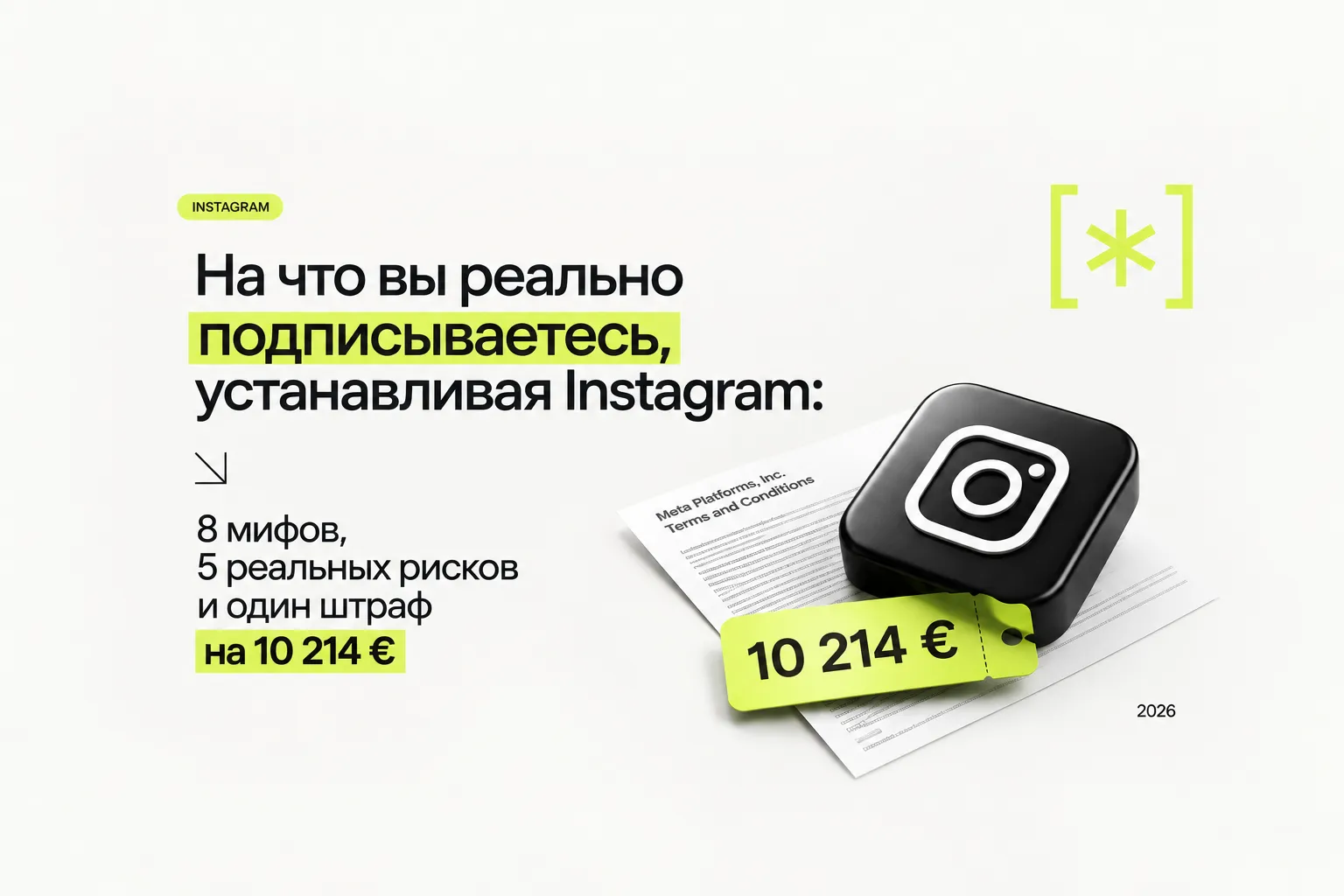
In short, for those in a hurry. Instagram does not own your photos — that is a myth. But it does own your access to your audience. It can cut that off in a day, with no explanation and no right of appeal. In 2025 tens of thousands of accounts around the world were caught in a wave of mistaken bans. And from 2 August 2026, new EU rules on labelling AI content apply, with fines of up to €15 million. Below I explain what the documents actually say, what the internet made up, and how to protect your business.
Why this article
Every few months a wave of panic sweeps Instagram. “Meta is taking our photos!”, “Copy this text to your stories or your data will be stolen!”, “We own nothing!”
At the same time, things happen that almost nobody writes about — and they are far more worrying than viral copy-paste posts.
I have been running accounts and building websites for more than ten years. And I have a personal experience that still stings. My public account about steampunk style was deleted in a single day. Several years of work, money spent on ads, a community I had built. I did everything verification asked for: I took a selfie with the code they sent me and submitted it. Before I sent it, the account was still visible. After that, it disappeared completely. I was given no option to appeal, no recovery form and no human to talk to.
I am not complaining; the past is the past. But what Meta did to me is a clear illustration of how the system works. It is also a reason to check the facts. What do Meta’s rules actually say, and what is available to us on Instagram? And what have users on the internet made up?
This article uses only sources you can check: Meta’s official documents, court rulings, regulators’ reports, and investigations by the Wall Street Journal and the BBC. I will mark every disputed claim:
| Label | What it means |
|---|---|
| ✅ OFFICIALLY CONFIRMED | It is in Meta’s documents, a court ruling or a regulator’s report |
| 📰 CONFIRMED BY INVESTIGATION | Documented by a major media outlet, often with a comment from Meta |
| ⚠️ UNCONFIRMED VERSION | Plausible, but there is no independent evidence |
| ❌ MYTH | Disproved by fact-checkers or by the original source |
Part 1. The myths about Instagram that go round the internet
Who owns your photos on Instagram?
In short: you do. The copyright stays with the author, and the documents say so in plain words.
The section of the Terms of Use called “Permissions You Give to Us” says:
“We do not claim ownership of your content that you post on or through the Service and you are free to share your content with anyone else, wherever you want.”
✅ OFFICIALLY CONFIRMED. Original source: instagram.com/about/legal/terms/
The law firm Gestalt Law puts it directly. Many people wrongly believe that Instagram takes ownership of every uploaded image. But the platform’s Terms of Use clearly say the opposite.
But. The same paragraph goes on with a second part of the sentence, and that is where it gets interesting.
What is the “licence” you give Meta?
The same clause continues:
“…you hereby grant to us a non-exclusive, royalty-free, transferable, sub-licensable, worldwide license to host, use, distribute, modify, run, copy, publicly perform or display, translate, and create derivative works of your content.”
It sounds scary. Let’s go through it word by word, in plain language.
🔹 Non-exclusive
You do not lose your rights. You can publish the same photo on your website or on Pinterest, or sell it to a stock photo site. Instagram does not become the only rights holder.
This is the most important word in the agreement, and it is exactly the one that the authors of panic posts don’t understand.
🔹 Royalty-free
Meta does not pay you for using your content. That is logical: you use the platform for free, and the platform uses your content for free to run its service.
🔹 Transferable + sub-licensable
This is where the real cause for concern begins. Meta can pass these rights on to third parties without asking you separately or telling you.
The Conversation warns about this. Technically, the platform can sublicense your photo to a third party without “giving any notice or offering any payment to the user”.
In practice, no large-scale abuse has been recorded. This wording is needed for the technical side of the service (CDNs, data storage partners, embedded posts). But legally the wording is very broad — Meta has covered itself well.
🔹 Worldwide
It applies all over the world. Nothing unusual in this wording, especially for an online service.
Does the licence end if I delete everything?
In short: YES, but with two important exceptions that few people know about.
The documents say: “This license will end when your content is deleted from our systems.”
The time frame is up to 90 days from the moment the deletion process starts.
Exception No. 1 (the main one). Say other users have used your content under the same licence: they shared it or saved it into their own post. If they have not deleted it, the licence stays in force until they do.
Exception No. 2. If immediate deletion is technically impossible, the content is deleted “as soon as technically feasible”. As you can see, this wording can stretch a long way.
✅ OFFICIALLY CONFIRMED
💡 A practical tip
In the settings you can turn off embedding of your posts on other websites. This does not cancel the licence. But it closes one of the ways your photos spread across the internet and stay there after you delete your account. The lawyers at LegalClarity give this advice.
How long does it take to read these documents?
In short: about 45 minutes. On average, people spend 2.
There is a well-known study by Obar and Oeldorf-Hirsch with a telling title, “The Biggest Lie on the Internet” (2018, a sample of 543 people):
- 74% of participants skipped the privacy policy of a test social network altogether by choosing “quick join”
- At an average reading speed, the policy would take 29–32 minutes to read, and the terms of use 15–17 minutes
- In reality, people spent 73 and 51 seconds on them
- 98% did not notice the absurd clauses planted on purpose. They were about passing data to intelligence agencies and giving up a first-born child as payment
The Conversation adds a detail that explains a lot. The Terms of Use are written at close to university reading level, but you can sign up for Instagram at 13.
There is even a project called ToS;DR (“Terms of Service; Didn’t Read”). Its motto is “‘I have read and agree to the Terms’ is the biggest lie on the web”. It gives services grades from A to E for how fair their terms are.
Part 2. Does Meta’s AI learn from our photos? The big scare of 2024–2026
Is it true that Meta trains its AI on my posts?
In short: yes, it is true — but only on public content. Private messages, no.
Meta’s wording (from its “Privacy Matters” post on generative AI, September 2023):
“Publicly shared posts from Instagram and Facebook and content from chats with our AIs — including photos and text — were part of the data used to train our AI models. We do not use the content of private messages with friends and family to train our AIs unless the user or someone in the chat chooses to share those messages with our AIs.”
✅ OFFICIALLY CONFIRMED. Source: Meta, “Privacy Matters” post on generative AI (September 2023); see also the generative AI section of Meta’s privacy pages — facebook.com/privacy/guide/genai/
The key distinction:
| Type of content | Used to train AI |
|---|---|
| Public posts, photos, Reels | ✅ Yes |
| Public comments | ✅ Yes |
| Chats with Meta AI | ✅ Yes |
| Private messages (DMs) with people | ❌ No |
| Private account | ❌ No |
| Profiles of users under 18 | ❌ No (according to Meta) |
Can you opt out? It depends on where you live
For those who live in Europe, this is probably the most useful part of the article.
🇪🇺 EU and UK: you DO have the right to object
A timeline worth knowing:
| Date | What happened |
|---|---|
| June 2024 | Meta announced training on Europeans’ data. After 11 complaints from noyb (Max Schrems) to the Irish regulator, the DPC, and action by the UK’s ICO, the launch was paused |
| 14 April 2025 | Meta announced it would resume. Data: public posts and comments of users aged 18+ |
| 12 May 2025 | Verbraucherzentrale NRW applied to the Higher Regional Court of Cologne for an interim injunction |
| 14 May 2025 | noyb sent Meta a formal cease-and-desist letter |
| 21 May 2025 | The Irish DPC approved the plan with conditions: transparency, an easy opt-out, de-identification |
| 23 May 2025 | The Cologne court (case 15 UKl 2/25) rejected the injunction — it found training on public data lawful |
| 27 May 2025 | The start date, and the deadline for filing an objection |
A key quote from Max Schrems that sums up the dispute well:
“This fight is essentially about whether to ask people for consent or simply take their data without it.”
Meta’s legal basis is Article 6(1)(f) GDPR, “legitimate interest”. That is exactly why you have the right to object — a working opt-out form in the settings.
✅ OFFICIALLY CONFIRMED (Cologne court ruling + DPC press release)
🇺🇸🇧🇷🇦🇺 US, Brazil, Australia: NO right to opt out
The US has no federal privacy law that would give this right. Meta’s statement, as quoted by MIT Technology Review:
“While we don’t currently have an opt-out feature, we’ve built in-platform tools that allow people to delete their personal information from chats with Meta AI across our apps.”
In other words: you cannot opt out of AI training on your data; you can only delete your chats with Meta AI. That is not the same thing.
Professor David Evan Harris (University of California, Berkeley) notes that the US has no standard right to opt out.
🇪🇺 Why this is an argument for Europe
If you run a business in the EU, you have tools your American peers don’t. These are the right to object, the right to data portability and the right to challenge moderation decisions under the DSA. Many people simply don’t use them because they don’t know about them. That is why I write more about this below, in the section on bans.
❌ MYTH: “Post this text to your stories and Meta can’t use your data”
This is the most widespread and most useless scare in Instagram’s history.
It is the copy-paste text that starts with “Goodbye Meta AI”. Or with “I do not give Meta or anyone else permission to use my personal data, profile information or photos”.
The scale. According to the BBC, hundreds of thousands of users reposted it, including celebrities. Among them were the actors James McAvoy and Julianne Moore and the American football star Tom Brady. TIME put the number at “more than 500,000 users”.
Why it doesn’t work:
- You have already signed the agreement. A one-sided post does not change the terms you accepted when you signed up. Contract law does not work like that anywhere in the world.
- Meta denied it directly. The company told the BBC: “sharing this story does not count as a valid form of objection”.
- Instagram itself labelled these posts as false (the “false information” label).
❌ MYTH. Debunked by: Snopes, TIME, ABC News, Reuters/Lead Stories, Euronews, PolitiFact, Malwarebytes.
What works instead: if you are in the EU or the UK, there is an objection form in your account settings. Filling it in takes five minutes — better than reposting a useless text.
❌ MYTH: “From 16 December, Meta will read private messages for its AI”
A scare from December 2025. Social Media Today debunked it. The privacy update of 16 December was only about using interactions with Meta AI to personalise recommendations, not about reading private messages.
What is true but rarely discussed: the photos in your phone’s gallery
In short: Facebook offers to upload to the cloud photos you have NOT yet posted.
In summer 2025 (TechCrunch report, 27 June 2025), Facebook started showing users a pop-up offering to turn on “cloud processing”. Here is how it works. When you create a story, the app offers to upload unpublished photos from your gallery to Meta’s servers. Meta’s AI then suggests collages, “memories” and retouching.
From 17 October 2025, the feature was rolled out to all users in the US and Canada.
Meta’s official answer (spokesperson Mari Melguizo, to The Verge):
“The camera roll media uploaded by this feature to make suggestions won’t be used to improve AI at Meta. Only if you edit the suggestions with our AI tools or publish those suggestions to Facebook, improvements to AI at Meta may be made.”
In other words, the uploaded photos themselves are not used for training. But if you edit a suggestion with their AI tools or publish the result, your photos may then help improve their models.
Criticism. Futurism and Malwarebytes pointed out how vague the wording is: unlike Google Photos, Meta gave no clear promise for the future. Asked directly how the data would be used later, the company declined to comment.
✅ OFFICIALLY CONFIRMED (the feature itself and the quote), with caveats about future use
🔧 How to turn it off
Settings → Preferences → Camera Roll Sharing Suggestions → turn off.
Part 3. The real risk: your account can be deleted in a day
Everything I described above is about data. But the main danger for a content creator is not that someone uses your photo. It is that one morning you open the Instagram app and see that your account is gone.
How often does Instagram ban by mistake? There is an official figure
In short: about one in ten content removals on Instagram is a mistake. Meta itself admits it.
In its Community Standards Enforcement Report for the third quarter of 2025, Meta published an accuracy metric for the first time:
- Removal accuracy on Facebook — more than 90%
- Removal accuracy on Instagram — more than 87%
The company’s own words: “about 1 out of every 10 pieces of content removed [is a mistake]”.
✅ OFFICIALLY CONFIRMED. Source: transparency.meta.com
An important gap: Meta’s reports have no metrics on account recovery — only on content. The company does not publish how many accounts were banned by mistake and how many were restored. This is a known transparency problem.
The 2025 wave of mass bans: what happened
📰 CONFIRMED BY INVESTIGATION
From late May to August 2025, a wave of blocks swept Instagram and Facebook. TechCrunch, the BBC, SFist, Dataconomy and Slashdot covered it.
What the BBC wrote: for months, tens of thousands of people around the world complained about mistaken bans of their Instagram and Facebook accounts. More than 500 of them contacted the BBC. They said they had lost precious photos, and some had seen their businesses turned upside down.
A particularly painful detail: some users were accused of breaking the rules on child sexual exploitation (CSE). In other words, the algorithm wrongly branded people as paedophiles.
A specific case. Yasmin Boussihmed from the Netherlands lost the Instagram profile of her boutique, with more than 5,000 followers. The account was restored only after the BBC contacted Meta’s press office.
Think about it: the way to get your account back that actually worked was to be mentioned in a BBC story.
How the anger grew. A petition on Change.org had “more than 4,000 signatures” (TechCrunch, 16 June 2025). Two weeks later it had “north of 25,500 signatures” and was still growing (TechCrunch, 2 July 2025).
Meta’s position. The company admitted a “technical error” only for Facebook Groups (June 2025) and denied a wider problem on Instagram. At the same time, it regularly reversed bans when the BBC raised specific cases.
A figure for context. In July 2025, Facebook said it had removed about 10 million profiles in the first half of the year. These profiles impersonated large content creators. Honest users inevitably got caught too.
Legal consequences. A law firm in Minnesota started looking for affected businesses to join a class action.
Is there an independent body you can complain to? Yes, and in the EU it works
Appeals Centre Europe is an independent out-of-court dispute settlement body set up under the Digital Services Act (DSA).
And here is a telling statistic: in the year to March 2026, the centre handled more than 4,600 cases about account bans. Meta provided evidence in fewer than 100 of them.
In other words, in more than 97% of cases the company simply did not explain why it had banned the person.
⚠️ An important caveat: decisions of Appeals Centre Europe are not legally binding — platforms only have to consider them “in good faith”. But the appeal itself often triggers a real review by a person.
What Zuckerberg admitted in January 2025
On 7 January 2025, Mark Zuckerberg published a video called “More speech and fewer mistakes”.
The key quote:
“We’ve reached a point where it’s just too many mistakes and too much censorship.”
What was announced:
- Ending third-party fact-checking in the US in favour of Community Notes (as on X)
- Softer rules on immigration and gender topics
- A higher confidence threshold for the algorithm before it removes content
- Moving the trust and safety teams from California to Texas
Zuckerberg was open about the trade-off:
“We’re going to catch less bad stuff, but we’ll also reduce the number of innocent people’s posts and accounts that we accidentally take down.”
He also pointed out the maths of the problem: at Meta’s scale, even 1% of errors means millions of affected users.
✅ OFFICIALLY CONFIRMED
Meta’s Oversight Board — is it any use?
In short: yes, but it looks at a tiny share of cases.
- Zuckerberg proposed the idea in 2018, and the board started work in 2020
- It is funded through an irrevocable trust of $130 million, with funding extended to 2028
- In five years — more than 200 published decisions and more than 300 recommendations
Criticism (the newsletter Platformer, Professor Kate Klonick of St John’s University): the board looks at only a tiny share of appeals. It cannot make Meta change its policies — only recommend.
Recent news that matters for creators:
- April 2025: the board criticised Meta’s January changes as hasty and made without assessing their impact on human rights
- January 2026: the board began consulting on its first case about permanent account bans
- June 2026: in its decision, it found “human rights concerns at the systemic level” in how bans work
This means the pressure on Meta is growing. But you should not count on it as a way to get your account back.
Part 4. Hacks, scammers and Meta staff: where the facts end
Here I will be especially careful with my wording, because this topic attracts the most speculation.
✅ FACT: Meta staff took over accounts and gave them back for bribes
CONFIRMED BY INVESTIGATION + an official comment from Meta
The Wall Street Journal investigation of 17 November 2022:
- Meta fired or disciplined more than two dozen employees and contractors
- The reason: improperly taking over and restoring accounts, in some cases for bribes of thousands of dollars
- The tool was called “Oops” (Online Operations). It was meant to restore accounts of VIPs, partners and employees’ relatives.
- Requests through it grew from 22,000 in 2017 to 50,270 in 2020
- Among those fired were security contractors from Allied Universal who had got access to internal tools
Meta’s official comment (communications director Andy Stone, to CNBC):
“Individuals selling fraudulent services are always targeting online platforms, including ours… People should never buy or sell accounts or pay for an account recovery service because doing so violates our Terms.”
⚠️ WHERE THE FACTS END
Confirmed: some employees and contractors abused an internal tool and took bribes. They were fired.
NOT confirmed: that Meta systematically restores accounts only for “insiders”, or that bans are deliberately arranged from inside. This is an ⚠️ UNCONFIRMED VERSION. Individual stories such as “slept with a Meta employee to get unbanned” are retold rumours with no independent confirmation.
I keep these apart on purpose. The real, confirmed facts here are worrying enough without mixing in rumours. Rumours only give people a reason to wave the whole problem away.
41 attorneys general wrote to Meta
✅ CONFIRMED
A coalition of 41 US state attorneys general sent Meta an official letter through the National Association of Attorneys General. Florida, Illinois, New York and Tennessee led it.
The reason was a sharp rise in complaints about hijacked accounts. In the letter’s words, hackers are “running rampant” on Instagram and Facebook.
The most quoted line of the letter:
“We refuse to operate as the customer service representatives of your company.”
The rise in complaints was linked to the layoff of about 11,000 employees in November 2022.
The attorneys general of 41 states told Meta they are tired of acting as its help desk. That says a lot about Meta’s support.
Why two-factor authentication does not always save you
This matters, because many people see 2FA as complete protection. The main ways around it:
| Method | How it works | How to protect yourself |
|---|---|---|
| SIM swap | A scammer gets your SIM card reissued and receives your SMS codes | Don’t use SMS for 2FA. Use an authenticator app only |
| Phishing | A fake email “from Instagram support” with a link to a copy of the login page | Check the sender’s domain. Instagram shows all its emails under Settings → Security → Emails from Instagram |
| Hacking through Meta Business Suite | Access comes through a linked business account or a compromised employee | Limit roles and regularly check the list of people with access |
| Session hijacking | An active session is stolen, bypassing login | Regularly check your active sessions and end any you don’t recognise |
And a paradox many people know first-hand (me included). A number of users reported that their account disappeared after they sent identity verification: a selfie with a code or a video selfie. Before sending, the account was visible; after, it vanished completely.
📰 Documented in user complaints and, in general terms, in media reports; Meta has given no systematic explanation.
Meta Verified: if you pay, will they help?
In short: not guaranteed. There are documented cases where paid support did not help.
What it is and what it costs (2026):
| Item | Value |
|---|---|
| Price (web) | about $11.99/month for one platform |
| Price (iOS/Android) | about $14.99/month |
| Launch | Australia/New Zealand — February 2023, US — March 2023, UK — May 2023 |
What it promises: a blue tick after an ID check and protection against people impersonating you. Also priority support with access to a live agent, exclusive stickers, and possibly more visibility (Meta itself does not guarantee it).
What happened in practice. TechCrunch, 2 July 2025, during the wave of bans:
“Customer service representatives, despite the premium fee, are allegedly proving dismissive and unhelpful. Accounts remain suspended, with paying users feeling abandoned when they need help the most.”
📰 CONFIRMED BY INVESTIGATION
Conclusion: a two-tier system
- Free user: there is almost no live support. A typical complaint from people who wrote to the BBC and on Reddit: “It feels like I’m shouting into a void”.
- Paying user: you can reach an agent, but the result is not guaranteed.
Be careful with promotional case stories. The internet is full of blogs like “Meta Verified solved my problem in 24 hours”. As a rule, these are agencies’ marketing materials, not independent checks. Read them critically.
Part 5. What else can cost you your account: bots and automation
Can you use bots on Instagram?
In short: the official API, yes. Third-party bots for mass following, no — and they are a direct reason for a ban.
❌ Not allowed by the rules
- Automation that imitates human behaviour at scale
- Mass following, mass liking, fake engagement
- Buying followers
- Third-party browser bots and scrapers that ask for your password (password-sharing tools)
✅ Allowed
- The official Instagram Graph API
- Post schedulers through approved partners (Business Solution Providers)
Documentation: developers.facebook.com/docs/instagram-platform
The chatbot rules people break most often
Consent is the point where most accounts get into trouble.
The 24-hour window rule
A user may contact you themselves: send you a direct message, reply to a story, leave a comment or tap the call-to-action of an ad. Then the business has 24 hours to message them freely.
Outside the window, you can only send template messages (message tags) or a One-Time Notification with clear consent.
Critical points:
- ❌ Cold mass messaging is not allowed. You cannot collect a list and message everyone.
- ❌ Following your account does NOT open the window. Someone following you is not permission to message them.
- ✅ You need a clear opt-in: the person must agree to get messages.
- ✅ In most jurisdictions you must disclose that people are talking to AI. Since August 2026 this is the law in the EU, not just a recommendation — see the next section.
About limits
Most automation services limit themselves to about 200 automatic messages an hour. It is important to understand that this is an industry convention, not a limit published by Meta. The official limits are set differently. For example, 300 messages a second for text, and 750 an hour for private replies to comments.
Is there such a thing as a shadowban?
In short: Meta does not use the word “shadowban”, but it admits to limiting recommendations. And it gives you a tool to check.
Since 2021 the app has had an “Account Status” section, where you can see:
- whether your content is limited in recommendations
- whether there are any violations
- whether you can appeal
Check your status right now. Many people go for years without knowing their content is limited in recommendations. They blame the drop in reach on “the algorithm”.
In 2025–2026 Meta stepped up its detection of aggressive automation. If your reach dropped sharply and for no clear reason after you connected an auto-like service, that is most likely the cause.
Part 6. How to post content without getting a fine: images, AI and music
This is the most practical part of the article. And the most underrated, because here we are talking about real demands for money, not hypothetical risks.
Other people’s images: why “I found it on Google” does not help you
The rule is simple: if you are not the author and you have no licence, you can’t use it.
What is NOT permission:
❌ The image came up in a Google search ❌ You credited the author (“not my photo, taken from the internet”) ❌ Someone else has already posted the image on Instagram ❌ You “don’t earn anything from it” ❌ You only used part of it
What you can use safely:
| Source | Detail |
|---|---|
| Your own photos | If there are people in the shot, you need their consent (in the EU this is also a GDPR matter) |
| Unsplash, Pexels, Pixabay | Read the licence. Some images have limits on commercial use |
| Paid stock photo sites | Check the licence type: editorial ≠ commercial |
| Creative Commons | Always check the type: CC BY-NC does not allow commercial use |
| AI-generated images | A separate topic — read about it below |
A particular risk in the EU: the German system of Abmahnung (a pre-court warning letter with a demand for money). Rights holders and specialised law firms scan social networks systematically. I will cover the size of the demands in the section on music.
🤖 Since 2 August 2026, AI-generated content is regulated by law in the EU
On 2 August 2026, Article 50 of the EU Artificial Intelligence Act (Regulation (EU) 2024/1689) started to apply.
What Article 50 requires
Four duties:
- Chatbots must say they are machines. The user must know they are talking to AI.
- Synthetic content — audio, images, video, text — must be marked as artificially generated (in a machine-readable format).
- Deepfakes must be labelled clearly and visibly.
- AI-generated texts published to inform the public on matters of public interest must be labelled.
Fines
Up to €15 million or 3% of worldwide turnover — whichever is higher.
Who it applies to
Not only EU companies. The duties “reach businesses wherever they are established”. They apply wherever a business is registered, if it serves users in the EU. A British or American company with a European audience is covered.
Important exceptions — breathe out
✅ No label is needed if AI only helps with standard editing, like fixing grammar, cropping or brightness. It must not change the content or its meaning much.
For systems placed on the market before 2 August 2026, the marking duty under Art. 50(2) is postponed to 2 December 2026. The EU Council and the European Parliament agreed this on 7 May 2026, as part of the Digital Omnibus.
✅ OFFICIALLY CONFIRMED. Original sources: digital-strategy.ec.europa.eu and artificialintelligenceact.eu/article/50/
And what does Meta itself require?
Alongside EU law, the platform has its own rules:
- Since May 2024 Meta has labelled content with an “AI info” label on Facebook, Instagram and Threads
- A label is required for photorealistic video and realistic-sounding audio that was digitally created or altered
- You have to add the label yourself — with a switch in the post, story or Reel settings before you publish
- Meta detects AI automatically through C2PA metadata: if you used Photoshop generative fill, DALL-E or Canva AI, the platform will see it by itself
- Meta’s own tools can add an “Imagined with AI” watermark, which stays even if the file is uploaded again
✅ OFFICIALLY CONFIRMED. Source: transparency.meta.com/governance/tracking-impact/labeling-ai-content/
💡 The practical takeaway
Label AI content yourself, and in advance. Three reasons:
- The automatic label will appear anyway — C2PA will give you away
- Since 2 August 2026 it is a legal requirement in the EU, with fines of up to €15 million
- Labelling it yourself looks honest; a forced label looks like an attempt to hide something
🎵 Music: real demands of up to €10,214 for one Reel
This is the most underrated risk for business accounts.
You take music from Instagram’s built-in library, which is the platform’s official tool. You post a Reel. A few weeks later, a letter arrives from a law firm demanding several thousand euros.
How can that be? Instagram has two different music libraries.
| Account type | Library available | What is in it |
|---|---|---|
| Personal | Instagram Music Library | Current hits, popular tracks |
| Business account | Facebook Sound Collection | A much smaller catalogue, usually without current hits |
Meta has agreements with collecting societies (in Germany, GEMA), but the rights granted cover only private use.
The rights holders’ key legal argument
Three points that German law firms rely on:
- The synchronisation right (Synchronisationsrecht). Putting music together with your video is a separate right that, under German copyright law, belongs only to the rights holder. GEMA does not grant synchronisation licences at all.
- Commercial character. Anyone who builds reach for a business is acting commercially, even if no specific product is advertised in the video.
- Making it available to the public — §19a UrhG, plus §97 UrhG, which gives the right to demand that you stop and pay damages.
Real amounts from real cases
📰 CONFIRMED — based on articles in specialised German legal publications
| Who demands | For what | Amount |
|---|---|---|
| Frommer.Legal (for the producer Kris Steininger, Crystals studio) | The song “Elfe” (performed by Dario Lessing) in one Reel | €10,214.99 in total, including €9,000 damages and legal costs |
| IPPC Law | The song “Pedro” (Jaxomy x Agatino Romero x Raffaella Carrà) | over €5,000 |
| Essex Music Group through Mathé Law Firm | “Feeling Good” in a social media video | Amount after details are provided |
| Kanzlei Prigge (description of its practice) | Various tracks | In one case, a demand of €10,000 |
Damages are calculated by “licence analogy” (Lizenzanalogie): the rights holder says it only grants commercial licences for five-figure sums — and demands matching compensation.
The scale. According to the retailers’ association Händlerbund (press release, February 2026), such warning letters have become a wave and often “slide into disproportion”. Lawyers note that rights holders deliberately go after accounts, not platforms — suing a small business is easier than suing Meta.
An aggravating factor: if a track is used in several Reels or stories, the demand multiplies.
⚠️ What is NOT a defence
❌ “I took the music straight from Instagram’s library” ❌ “I didn’t earn anything from it” ❌ “It only played for 10 seconds, in the background” ❌ “The track is not registered with GEMA” — GEMA does not represent all authors, so not being in its register guarantees nothing ❌ “I deleted the Reel right after the letter” — the demand still stands
✅ How to do it right
Option 1 — free. Use the Facebook Sound Collection, the library officially meant for business accounts. The catalogue is smaller, but the rights are clear.
Option 2 — paid licensed libraries. Lawyers name specific services where you can buy rights for commercial use on social media:
- Artlist
- Epidemic Sound
- Shutterstock Music
- AudioJungle
- Audio Network
Option 3. Your own music, or music commissioned from a composer with the rights transferred to you.
Option 4. No music at all — voice, ambient sound, subtitles. Many formats work perfectly well without a track, and it is also better for accessibility.
🚨 What to do if the letter has already arrived
- Don’t pay at once and don’t sign anything. Lawyers agree that the demands are often inflated. The wording of the proposed undertaking (strafbewehrte Unterlassungserklärung) can also be broader than needed.
- Don’t ignore it. The deadline is usually short, and the next step is court.
- Get advice from a legal professional who works on copyright. The amount and the scope of the undertaking can often be reduced a lot.
- Check your archive and delete the other videos with this track, but take screenshots of what was published first.
Part 7. The main conclusion: a social network is rented land
There is an exact term for what happens to content creators: digital sharecropping. Nicholas Carr coined it back in 2006:
“The distribution of production into the hands of the many and the concentration of the economic rewards into the hands of the few.”
You produce the content. The platform collects the value. The land is not yours.
Marketing sorts channels into paid / owned / earned media. And here is the main sleight of hand the whole industry is built on: a social media account is treated as “owned media”. That is wrong. It is rented.
Imagine a landlord who can evict you in a day, with no warning, no reason and no right to challenge it. Nobody would buy a shop on those terms. Yet on the internet, millions of people build their business on exactly these terms.
Point-by-point comparison
| Social media account | Your own website | |
|---|---|---|
| Who decides whether your page stays | The platform. The algorithm. A moderator in Texas | You |
| Can you lose it in a day | ✅ Yes, with no explanation | ❌ Hardly ever |
| Is there an appeal | Formally yes, in reality it is “shouting into a void” | The question doesn’t come up |
| Who owns the audience | The platform. You can’t export your followers | You — an email list can be exported |
| Who controls reach | The algorithm. It can cut your recommendations to zero | You + search engines, and the rules are clear |
| Can you move it | ❌ No | ✅ Yes — a domain can be moved to any registrar |
| Cost to start | €0 | about €15–25 a year for a domain |
| Cost of hosting | — | €0 on free plans |
What your own platform really costs
An answer that surprises people: about €15–25 a year.
Domain
Cloudflare Registrar sells domains at cost, with no markup. Namecheap charges $15.98 to register a .com and $19.98 a year to renew it (prices from 1 November 2026). A rough guide: €15–25 a year.
Free hosting, and it is not a cut-down demo
| Service | Free plan (2026) | Details |
|---|---|---|
| Cloudflare Pages | Unlimited bandwidth, 500 builds/month, up to 100 custom domains per project, up to 100 projects, up to 20,000 files, automatic SSL | The best option for most people. 1 build at a time |
| GitHub Pages | about 100 GB of bandwidth/month, up to 1 GB of storage, 10 builds/hour, a custom domain + free HTTPS | ⚠️ Running a business on it is directly forbidden by its rules. Not suitable for business |
| Netlify | Since 4 September 2025, a credit model: 300 credits/month (about 15 GB of bandwidth). When credits run out, the project is paused until the next cycle | Older accounts kept their previous plan |
In total: a secure website with unlimited bandwidth that belongs only to you costs about as much as a few cups of coffee a year.
Honest counter-arguments: where a website loses
I won’t pretend a website solves everything. Here is where a social network is clearly stronger:
1. Distribution. Instagram has an algorithm that can show your Reel to a million people for free. A new website starts from zero organic reach, and SEO takes months.
2. A website also depends on third parties. Google (indexing), the domain registrar, hosting, CDN, DNS. This is partly someone else’s infrastructure too.
But the difference is fundamental: these dependencies can be spread out and moved. Don’t like your hosting? Move in an hour. Problems with the registrar? Transfer the domain. Google traffic dropped? You still have direct visits and your email list. From a blocked Instagram account you take away nothing.
The right strategy is not “or”, but “and”:
Social media (reach, attracting people)  →  Website (conversion, trust, archive)
                                                         ↓
                                     Email list (what nobody can take from you)
Social media fans have a good line: “Owning 10% of something is better than owning 100% of nothing”. It is true. But it does not remove the need to have a home, not just a tent on someone else’s land.
❓ Frequently asked questions
Can Instagram use my photo in ads without my permission?
Today, no — the terms do not provide for selling your photos to advertisers. But the history is telling. The 2012 version of the terms let businesses pay Instagram to show “your username, likeness, photos, and/or actions you take” in ads. The author would get nothing. After a public outcry, co-founder Kevin Systrom apologised publicly and wrote that “it is not our intention to sell your photos”. Instagram then went back to its old advertising wording. Today your actions and interests are used for ad targeting — this is described in the privacy policy.
If I delete my account, will Meta’s AI “unlearn” what it learned from my photos?
No. In practice, training a model cannot be undone — you cannot pull specific data out of a trained AI model. That is why it makes sense to object before your content is used, not after.
My account is private. Are my photos used to train AI?
According to Meta, no: only publicly shared content is used for training. But remember: if you share something with Meta AI in a chat, that is a different category.
My account was deleted. What should I do right now?
- Take screenshots of everything — the block notice, the date, the wording of the reason
- Appeal at once and everywhere you can (inside Instagram, Facebook, by email and so on) — time limits apply
- If you are in the EU, go to Appeals Centre Europe (the out-of-court body under the DSA). An appeal there often triggers a review by a person
- If the account is commercially valuable, a letter to Meta from a legal professional often works where the forms don’t
- Never pay “specialists with contacts at Meta” — this is exactly the grey market that got employees fired. You will break the terms and will most likely lose your money
What should I do today to protect my account?
- Turn on 2FA with an authenticator app, not SMS
- Download an archive of your content (Settings → Your information and permissions → Download your information)
- Check Account Status for hidden limits
- Turn off Camera Roll Sharing Suggestions
- If you are in the EU, file an objection to AI training
- Check which library you take music from
- Buy a domain and set up a landing page that collects emails
Is it true that free hosting is “not real”?
Cloudflare Pages gives you unlimited bandwidth, SSL and up to 100 custom domains on the free plan. This is full production hosting for static sites, not a demo. The limit is that the site must be static (which is ideal for a landing page, portfolio, blog or business-card site).
How big is the risk of a music copyright letter if I am not in Germany?
Germany is the most active jurisdiction because of the Abmahnung system, which makes such demands profitable for law firms. But copyright protects a track in every country. If your audience or your business registration is in the EU, the risk is real.
What to do next: a step-by-step plan
Today (30 minutes, €0)
Go through the checklist above. Above all — download your archive and check your 2FA.
This week (about €15–25 a year)
Buy a domain and put a landing page on Cloudflare Pages. Even one page with a description of your services and a sign-up form is already an asset that belongs to you.
This month
Start building an email list. It is the only channel to your audience that nobody can take away from you. Even 200 addresses are 200 people you can reach whatever happens.
A sign that you need to act urgently
If more than 30% of your sales or traffic comes from one platform, that is a critical dependency. Spread it out at once.
Sources
Meta’s official documents
- Instagram Terms of Use:
instagram.com/about/legal/terms/ - Meta Privacy Policy:
facebook.com/privacy/policy/ - Section on generative AI:
facebook.com/privacy/guide/genai/ - Meta’s transparency site and reports:
transparency.meta.com - Labelling AI content:
transparency.meta.com/governance/tracking-impact/labeling-ai-content/ - Developer documentation:
developers.facebook.com/docs/instagram-platform
EU law
- Article 50 of the AI Act:
artificialintelligenceact.eu/article/50/ - European Commission guidelines:
digital-strategy.ec.europa.eu/en/policies/guidelines-transparency-ai-generated-content
Hosting
developers.cloudflare.com/pages/platform/limitsdocs.netlify.comdocs.github.com(GitHub Pages limits section)
Investigations and analysis
- Wall Street Journal, 17.11.2022 — investigation into the internal “Oops” tool
- BBC, 2025 — reports on the wave of mistaken bans
- TechCrunch, 16.06.2025 and 02.07.2025 — coverage of the blocks and of Meta Verified
- WBS.LEGAL, Prigge Recht, Händlerbund — practice on music claims in Germany
⚠️ Disclaimer
This material is for information only and is not legal advice. Meta’s terms and policies change regularly. All data is current as of November 2026, but check the original sources linked above before making decisions. Terms of use can differ by region: there is a separate version for the EU/EEA. If you receive an official demand, consult a legal professional who works on copyright in your jurisdiction.
If you found this article useful, share it with people who build a business on social media.