The first part of the research is in the previous article. It covers current problems of the course business, promising models and formats of online products, and niches and topics. It also covers buyer behaviour, promotion strategies, sales funnels and automation.
Expert views and statistics: what the numbers say
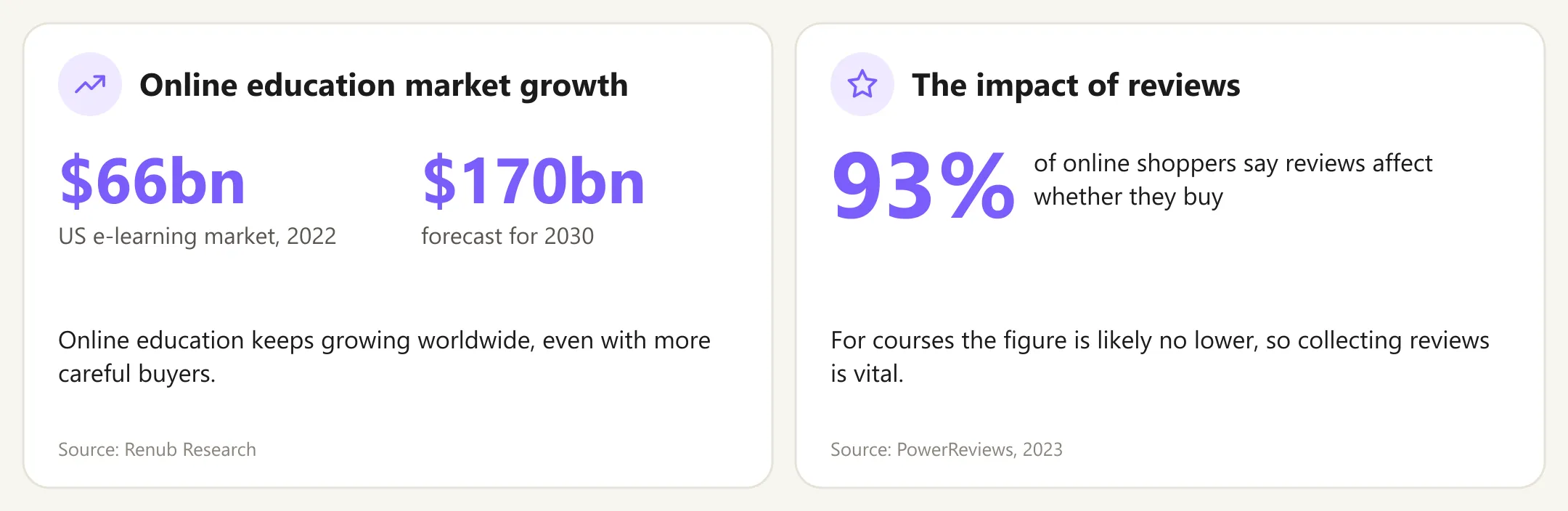
- Market size and growth: Online education keeps growing worldwide. In the USA, the e-learning market was valued at $66 billion in 2022 and is forecast to reach $170 billion by 2030. This includes the corporate sector and higher education, but it reflects the general trend — the move to digital. At the same time, buyer mood is unstable. A 2023 NielsenIQ survey showed that, because of inflation, many consumers worldwide felt worse off and became more careful with money. This indirectly affects courses too: people ask themselves whether they really need this expense.
- Trust in reviews: As we mentioned, 93% of online shoppers say reviews affect whether they buy. We can assume the figure is no lower for courses — buying an invisible service feels riskier than buying a product. So collecting reviews is a vital part of your strategy.
- Course completion: A well-known problem is low completion. In studies of free online courses (MOOCs), only a small share of those who enrolled finished. That is why there is now such a focus on engagement, short modules and gamification, to improve these figures. Game mechanics (points, badges) are one way to raise motivation. To get people through a course, you often need extra motivation.
- Short videos: Short videos are now one of the most-watched formats online. For marketers, this is a direct signal: you can’t ignore this format if you want to reach a wide audience.
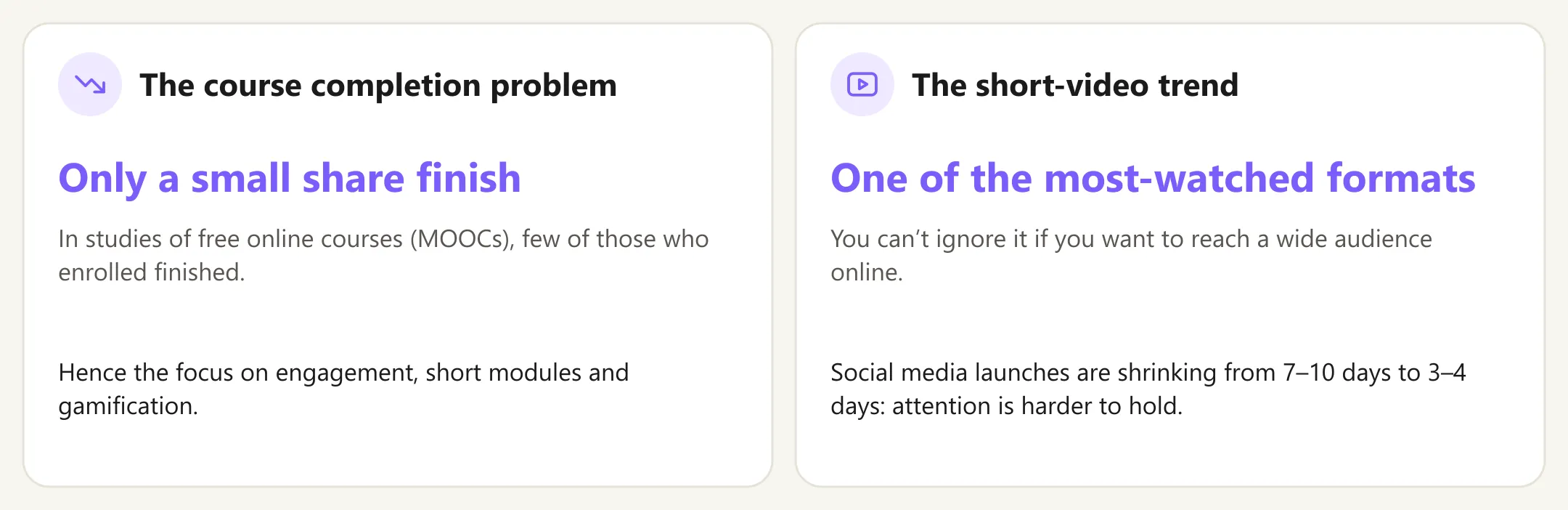
- Launch length and attention: Classic 7–10-day social media launches are shrinking to 3–4 days, because it is hard to hold attention. Multi-day warm-up series can get boring — people value their time. This matches the general decline of attention span on social media.
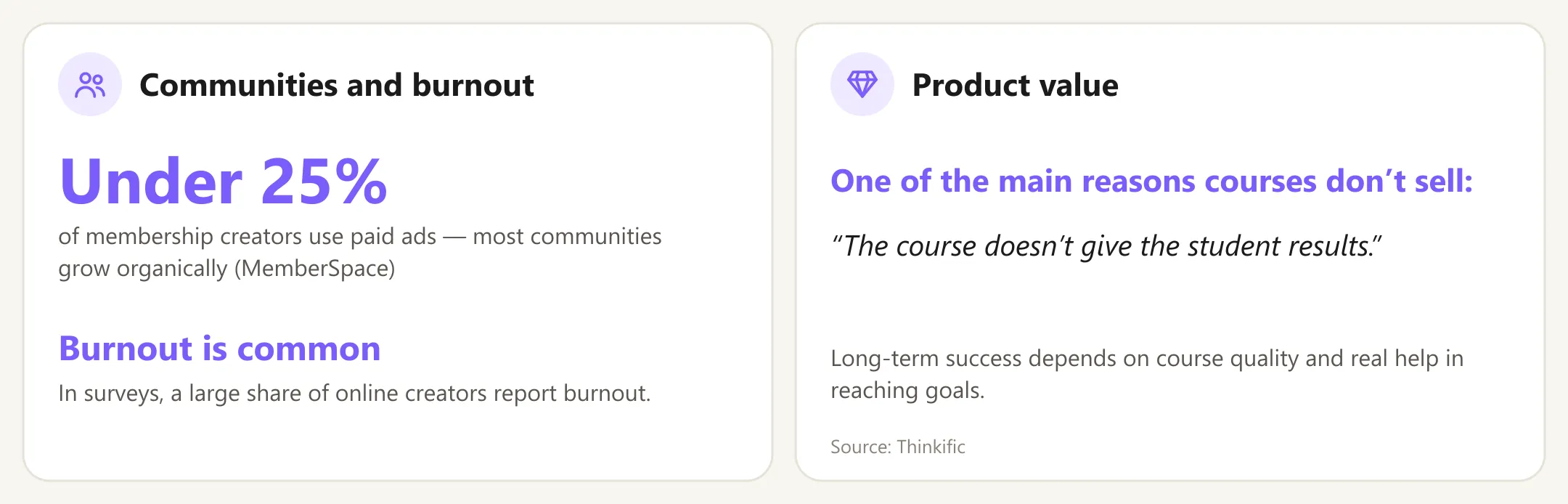
- The subscription economy: Figures from MemberSpace: fewer than 25% of membership creators use paid ads — most communities grow organically. This shows the power of word of mouth in loyal communities.
- Creator burnout: In surveys, a large share of online creators report burnout. Even successful entrepreneurs (whose launches earn tens of thousands) have thought about taking a break or changing their work. This is an important factor. The emotional health of the authors themselves affects the industry. If an expert gives everything up, their students are left on their own.
- Sales vs. value: Thinkific (a course platform) listed the top 6 reasons why online courses don’t sell. One of the main ones is that the course doesn’t give the student results or value. So the reason for failure is often not the marketing but the product itself. This supports the shift in thinking. In the long run, the winners are those with a good course that helps people reach their goals. Then the sales will come.
Practical tips for online entrepreneurs (course creators)
1. Put the customer’s benefit and results at the centre. In 2025, the winner will be the one whose product helps people reach the stated goals. Audit your courses: what results do your students get? Collect case studies and figures. If you find gaps, improve the programme: add practice and support to make it more effective. In marketing, focus not on “what a great expert I am” but on what the student will get — backed by proof (reviews, progress figures). Principle: less hype, more specifics and value.
2. Work on your audience’s trust. Trust is now your main asset. Build it through transparency: tell your story honestly, show what happens behind the scenes of your work, share expert content for free. Publish case studies and reviews on all platforms. Trust is hard to win but easy to lose, so no false promises in your ads, and don’t exaggerate results. Better to beat a modest forecast than to raise unrealistic expectations and disappoint. Invest time in talking to your audience (reply to comments and questions). When people feel a personal connection, loyalty grows.
3. Focus on your “core” and build a community. Instead of racing for new followers, pay attention to those who already read and trust you. Identify the core of your most active fans — and work for them: hold closed live sessions, give them a sense of belonging. Create a community (a group, a club) around your brand, where people can talk to each other. This will increase engagement and value, and turn your fans into brand advocates. Remember the idea of 1,000 true fans: you don’t need millions of followers. A few hundred devoted fans who will buy everything you offer and bring their friends are enough.
4. Diversify your product line and introduce a “value ladder”. In today’s market, a multi-level product line works well:
- Free content (social media, webinars) — to attract and warm up.
- Cheap mini-products (€10–50) — a book, a mini-course, a workshop, so a new customer can try you with minimal risk.
- The main course or programme — your flagship product with full value.
- Advanced level or coaching — a premium product for your best customers (VIP mentoring, a live intensive, an expert review and so on).
- Subscription or community — for those who finished the course and want to keep getting value and contact on an ongoing basis.
This structure lets you earn as much as possible from each customer without scaring them off with a high price at the start. Try to make sure a person can grow with you: they finished the basic course — offer the next step. Introduce continuous sales: don’t rely on one-off launches; always have something to offer, even something small. This will smooth out cash-flow gaps and increase LTV (how much one customer spends with you over time).
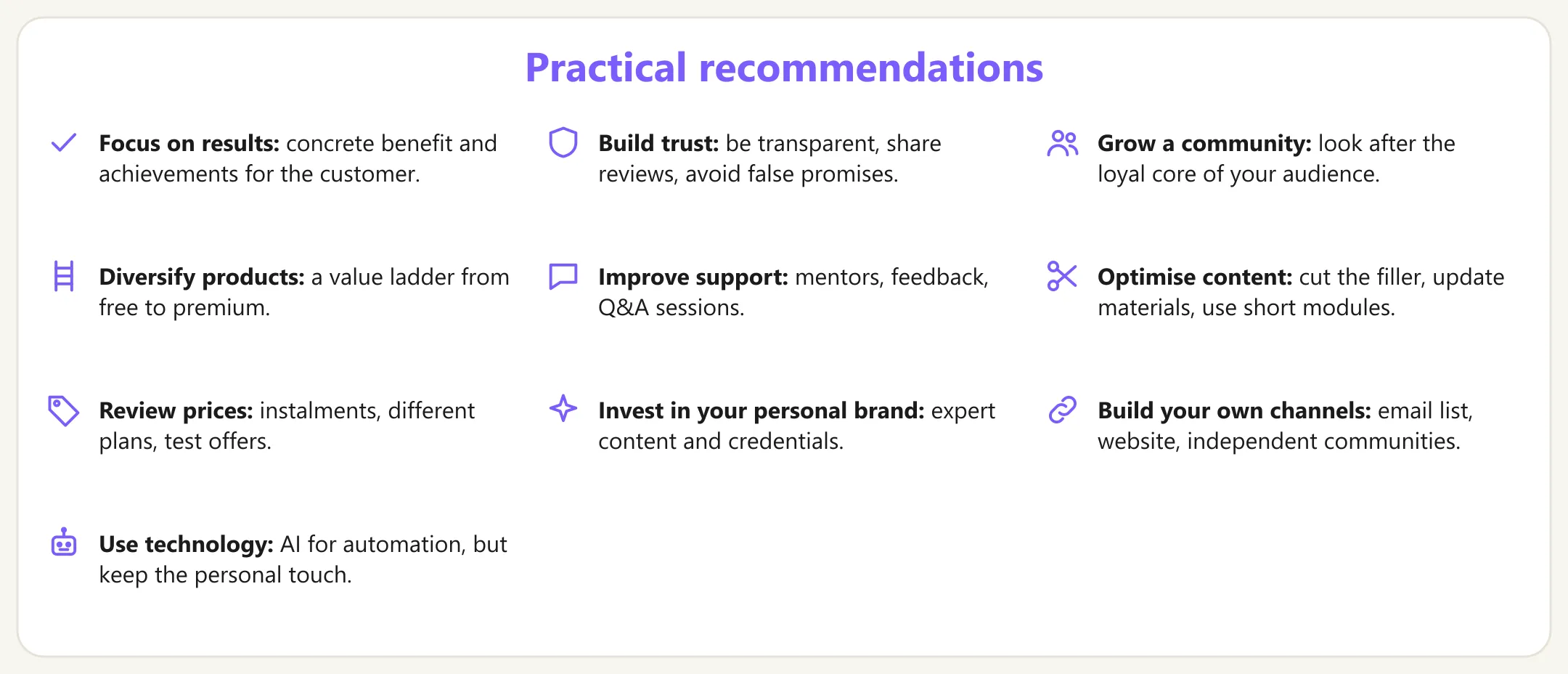
5. Improve support and contact in your courses. Make your product “warmer”: add tutors, feedback and interaction. You can hire an assistant or use graduates as mentors if you don’t have time yourself. Create a group chat where you answer questions at least once a day. Plan Q&A sessions during the course. Personalise contact: address students by name and ask about their progress (this can be automated with email surveys). The goal is for people to feel you care about their success. This raises the completion rate, satisfaction and the chance of recommendations.
6. Cut the “filler” and update your content. Review your materials: brevity is valued now. If a course is too long, think about what can be removed or made optional. You can rework the programme into smaller modules, so the student isn’t scared by the volume. Be sure to update outdated parts. It’s 2025, so remove five-year-old examples and add current cases and new techniques (for example, AI tools, if they fit your topic). Show your audience that you follow trends and your course is fresh. You can stress this in marketing: “the programme has been updated for 2025”.
7. Review your pricing in light of the situation. If sales have dropped, don’t be afraid to experiment with prices and formats:
- Offer instalments for expensive programmes (through Klarna, PayPal Credit or manually). Interest-free instalments over 3–6 months will make your course more affordable and remove the price objection.
- Create several plans: basic (recordings only), standard (recordings + tutor), premium (recordings + personal coaching). This way you reach groups with different budgets. Many people will pay more for personal work, and some will choose the budget option rather than buy nothing.
- Test discounts or bonuses for a limited group (for example, run a secret sale for subscribers). Look at how demand reacts to price — perhaps a small price cut will greatly raise conversion and final profit.
- Watch your competitors: perhaps your prices need adjusting to the market. But don’t undercut heavily — better to add value. People will pay a premium if they see what they are paying for.
8. Invest in your personal brand and expertise. Trust in the course business as a whole has been damaged. Now the reputation of your personal brand is your shield. Make time to create expert content that isn’t direct selling: articles, answers in professional communities, appearing on podcasts or speaking at conferences. Maybe publish a small e-book or run a free challenge. This will strengthen your status as a recognised public expert, not just a course seller. People are more likely to buy from someone they see as a true professional. Also, if you can, get proof of your expertise: certificates, membership of respected organisations, case studies with well-known clients. Then use these credentials in marketing (“ICF-certified coach”, “Expert with 10 years’ experience, author of the book …”). Just don’t overdo it — status must be backed by real content.
If you want to learn to work with AI tools and make them your assistants at work, I invite you to my AI lessons on Patreon (in Russian):
Build your own channels — so you don’t depend on other people’s platforms
9. Build your own channels — so you don’t depend on other people’s platforms. Social media algorithms can change at any moment. So be sure to grow your own platforms:
-
Put real benefit and results for the student first. Make sure each of your courses or products gives a concrete, measurable result. Aim for a skill-based format — so that by the end the student can really do what they learned. Drop excess “filler” and theory for its own sake. Fewer modules with practice and a final project are better than a huge lecture course with no application. In promotional materials, stress what the student will be able to do or achieve after the course. For example: “get a job as a junior developer in 3 months” or “get rid of your fear of public speaking”. And of course, back up these promises with proof — real student cases, reviews with figures and facts. It is hard to sell “learning for its own sake” now — people pay for results.
-
Restore and keep trust. Transparency and honesty are your main strategy against the crisis of trust. Be open with your audience: talk about your expertise, but don’t be afraid to admit its limits — what your course won’t give. Promise only what you can deliver. Show what happens behind the scenes: how you prepare lessons, how you talk to students — let the audience see how involved you are. Be sure to collect students’ reviews and successes and share them on all platforms. Start a “graduate success story” series — such material greatly increases trust. Avoid pushy pressure tactics and empty hype in ads: today’s Western customers spot them at once and are put off. Use ethical marketing instead: talk about values, show your human side, speak the language of benefits, but without hype. Trust takes a long time to build, but then it works for you — loyal customers will buy new products and recommend you to others.
-
Focus on your core of loyal fans and build a community. Stop chasing only new leads. Work with the audience you already have instead — turn followers into a real community. Set up closed chats or groups for your customers and like-minded people. Run special live sessions for them, give bonus content and ask for feedback. Your goal is for people to feel not just like buyers but like members of a community. This approach strengthens the emotional bond with the brand. In a community, members motivate each other to learn and share their successes. You also gain brand advocates who talk about you to others of their own free will. Also, it is easier to sell new products inside a loyal core (they already trust you). An idea: launch a referral programme for community members, so they bring friends for a reward. This both grows your base and strengthens the sense of belonging. Remember: 500 “true fans” who will buy everything and support you are better than 50,000 random followers who don’t really care.
-
Diversify your product line and introduce multi-level income. Don’t limit yourself to one big course. Build a “value ladder” with several steps:
- Free content — useful posts, videos, checklists, webinars. This attracts a new audience and lets people try your expertise without risk.
- A cheap entry product (a mini-course, a low-cost online challenge, a book) — something for €10–50 that solves a small problem or gives basic knowledge. For example, a one-hour workshop or a PDF guide. This lowers the entry barrier — the person becomes a paying customer, even if they spend only a little.
- The main flagship product — your key course or mentoring programme. This is where you deliver full value for the customer’s main need. The price can be substantial (several hundred euros or more).
- Advanced level or premium service — for those who finished the main programme and want more. For example, an advanced course, one-to-one coaching, a VIP membership with personal contact. This is a more expensive segment aimed at the most motivated.
- A subscription or graduates’ club — ongoing income. For example, a monthly club for €X with access to exclusive materials, regular meetings or content updates.
This multi-step model covers different audience segments and lets each customer follow their own path. A beginner can start with free content, move to a cheap product, grow into an expensive course and then stay on a subscription. In the end you get both breadth (more people will try cheap things) and depth (those who reach the top bring the most income). The main thing is to link these steps logically, so one flows smoothly into the next. And watch the quality at every stage: if the mini-product is weak or empty, people are unlikely to buy the big course. Each level should delight the customer and make them want to move on.
-
Strengthen support and guidance for students. A mark of successful courses now is generous support. Try to make sure your customers never feel abandoned. Add live elements: tutor reviews of homework, regular Q&A sessions, personal consultations (even short ones). If you sell at scale and can’t cope personally, hire assistants or bring in your best graduates as mentors. Create a space where people can ask a question and get an answer within a reasonable time. Choose whatever is convenient. It can be a closed group, a forum or a chat. Encourage students to help each other (peer-to-peer learning) — this both takes load off you and increases engagement. Students who feel supported are much more likely to finish the course and get results. This means they will be satisfied and leave a good review. Motto: “don’t just sell video recordings — sell a guided transformation”. Include an element of mentoring or feedback in the course price. Even if the price goes up, conversion may improve, because the value in the buyer’s eyes will grow.
-
Adapt the length and format of learning to today’s busy customer. Review your programmes for length and structure. If a course runs for 3–4 months, split it into modules or stages, so there are “quick wins”. These are interim results the student reaches in 2–3 weeks without waiting for the end. Many creators note that shorter courses or intensives work better now. It may be worth making a series of micro-courses instead of one huge course. Then the customer can buy step by step, and it is easier for you to sell (starting small). Also vary the format. Mix video with interactive tasks and add audio versions of lessons (many people like to learn on the go). Make summaries and checklists for the videos. This way, people with different learning styles get the most out of it. Gamification helps too: add points, badges for completed lessons and small challenges inside the course. This encourages people to keep going. Also make sure your platform is easy to use on mobile devices (most of your students may log in from a phone). The easier it is to access the materials, the higher the engagement. In short: respect the student’s time and effort — make learning convenient, logical and manageable, and the results will follow.
-
Review your pricing and payment terms. People’s ability to pay varies now, and many are cutting their budgets. A good move is to make your offer more flexible financially. First, offer instalments for expensive programmes. For the USA and Europe, you can add services like Klarna, Affirm, PayPal Pay in 4 and so on, or even accept monthly payments manually. Many people find €100 a month easier to accept than €600 at once. Second, think about different participation packages: for example, Standard (basic content), Pro (content + consultations) and VIP (content + personal coaching with you). The price difference is big, and everyone chooses what they can afford. You will be surprised — there will be takers for the more expensive VIP too, if the value is high. Third, don’t be afraid to run promotions and discounts — but wisely. For example, a limited discount “for newsletter subscribers only” or a bonus for paying quickly. Discounts are now not as discredited as they were a couple of years ago — consumers themselves look for good deals because of inflation. The main thing is not to slip into permanent discounting, which undermines value. Also clearly state your refund policy: give an honest guarantee — say, money back within 14 days if they don’t like it. This will reduce the fear of buying. Analyse your funnel: at which stage do people drop off? Perhaps you ask for full payment too early — then add a deposit stage or a trial period. Flexibility and customer focus in payment matter more than ever now.
-
Invest in your personal brand and expertise. In a saturated market, people follow a “name”. Keep building yourself as an expert: publish in industry media, speak at conferences (online or offline), start a podcast or YouTube show on your topic. This doesn’t bring instant sales, but it creates a long-term stream of trust. When you are interviewed or quoted as a specialist, potential customers start to take you more seriously. It is also useful to collect formal credentials: certificates, membership of professional communities and awards if you have them. For example, ICF for a coach, Google certification for a marketer and so on. Mention them on your website — this increases your social proof. But above all, show your expertise in action. Run a blog with analytical articles and do small free case reviews. Let people see that you are deep in the topic and really know your stuff. One more point — personal brand = personality. Add individuality: tell the story of why you came into the profession, share your values and vision. In the English-speaking course business, the trend now is a humanised brand. The expert doesn’t hide behind a company facade but talks sincerely and sometimes admits their weak spots. This really wins people over. The stronger your personal brand, the easier all your later launches will be — people already trust you like an old friend.
-
Build independent channels to your audience. Don’t leave all your communication to social media algorithms. Tomorrow Facebook or Instagram may cut your reach even more or block your account altogether — and you will lose contact with your followers. So at every opportunity move people to your own channels: above all, build an email list. An email newsletter is still one of the most reliable ways to reach a customer (most people check their email every day). Offer a digest subscription or a free mini-course by email — anything to get addresses. Then work with this list regularly: send useful emails, not only sales ones. Make sure people link your newsletter with value, not spam — then people won’t unsubscribe. Besides email, develop your own website or blog with SEO content. Let people find you through search — this diversifies your traffic. It helps if the website has a sign-up form or a community. Consider creating your own space for the community: for example, a forum on your website, a Slack or Discord channel, or a separate app. Yes, not everyone will leave convenient social networks, but your core will, and it will be your zone of direct influence. Independent channels are the key to stability: whatever upheavals happen, you always have a way to get your message to your audience. Plus, on your own platforms you aren’t limited by formats. You can send long emails, audio messages, anything — without fear that an algorithm will cut your reach.
-
Use technology and automation, but without losing the personal touch. Modern tools can make your work much easier. It would be a shame not to use them. There are many examples: AI tools can save time on preparing materials, and automation saves time on routine contact. Take AI onto your team as an assistant. For example, use ChatGPT or similar tools for text drafts, idea generation and lesson plans. It won’t replace your experience, but it will speed up brainstorming. There are AI services for quickly making transcripts and translations of your videos. Upload a recording, and a minute later you have text in several languages to work with.
AI tutors and chatbot helpers for students are also being tested. They can answer common questions 24/7 or point to course material, taking load off you and your team. Look at marketing automation tools: email series (welcome sequences, abandoned cart reminders), trigger emails based on user actions, automatic audience segmentation. All this can be done on platforms like ActiveCampaign and others. Spend the time to set it up once, and then it runs on its own.
However, it is important not to overdo it: people value technology, but they value live attention even more. So make sure your automated emails and messages are written with heart (or at least feel that way). Check the content AI generates for you, and add your own unique vision and tone of voice. And don’t hide completely behind bots: show up in person where it matters. For example, answer questions in the chat yourself once a week, even if there is a moderator bot. Used well, technology will give you a huge advantage — you will get more done without burning out and keep quality high. Just find the balance: automate processes, not relationships.
Practical tips for social media specialists and content marketers
1. Follow platform trends. Your role is to be the first to bring your client what is “taking off” on social media right now. Today the clear trend is short video. It gives record reach and ROI among all content types. So you need to master making Reels, TikToks and YouTube Shorts on your client’s topic. Think about how to turn expert content into catchy 30-second videos (for example, short clips with tips, behind-the-scenes moments from teaching, mini success stories). At the same time, study new features: algorithms often boost the formats they are promoting (Stories, polls, videos with new effects and so on).
Experiment and stay flexible. For example, X (formerly Twitter) may introduce a new audio chat feature. Think about how an expert could use it (maybe for voice Q&As). Or if LinkedIn develops its “News” section, try posting an article there on behalf of your client. A social media specialist in 2025 is a lifelong learner, because the digital environment changes at lightning speed. Set aside time for your own research: read industry blogs and reports (Sprout Social, for example, publishes summaries), join webinars on new social media features. Clients value specialists who are on top of trends and can offer fresh ideas based on trends.
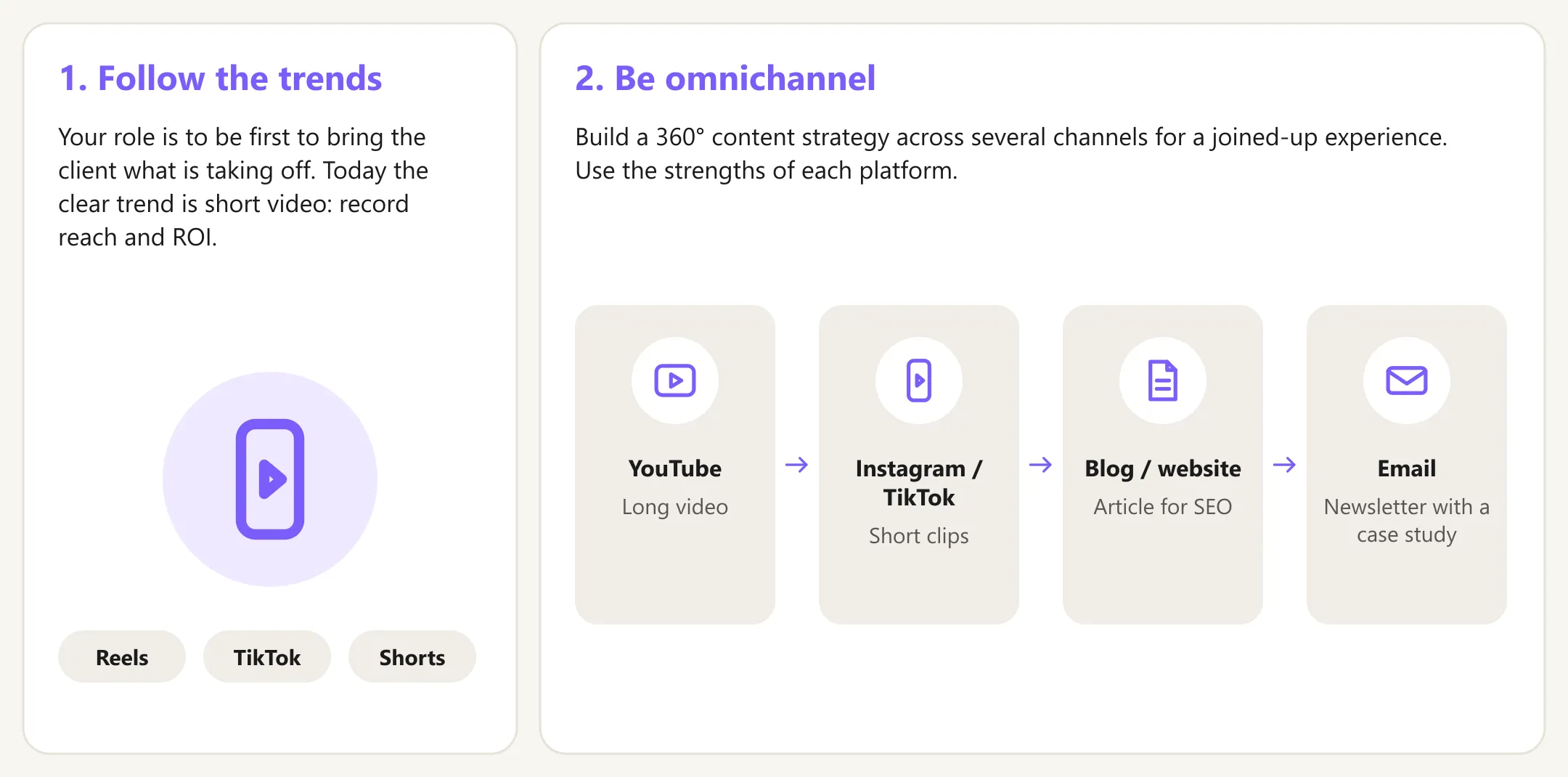
2. Diversify content and platforms — be omnichannel. The days when the audience sat in just one channel are gone. People may find a brand through TikTok, then check its Instagram, read reviews on Google and then sign up for the newsletter. Your strategy should cover several channels and give the user a joined-up experience. Develop a 360° content strategy with your client. For example: a long educational video on YouTube (for deep engagement) + short clips from it on social media (for reach). Add a blog article on the same topic (for SEO and trust) + a newsletter with a case study (for retention). Of course, budget and resources don’t always allow you to cover everything. But try to combine at least 2–3 channels, so you don’t put all your eggs in one basket. Also, people prefer different formats at different times. In the morning they may watch Stories, in the afternoon read a post, in the evening put on a podcast.
Use the strengths of each medium. Instagram is visual and short, LinkedIn is for business reputation. YouTube is for teaching and showing expertise, TikTok is for viral reach and a younger audience. Promote your client where their target audience spends time, adapting the form. And don’t forget interactive content: run polls, quizzes and mini-games in Stories, and launch challenges. Algorithms like it when people don’t just watch passively but interact (react, vote). Such mechanics increase engagement and reach, and also give you valuable insights into what your audience prefers.
3. Bet on authenticity, a human face for the brand and storytelling. Course topics are often complex or abstract. The task of social media is to make them human and relatable. Move away from a dry “corporate” style, even if you are promoting a serious expert. Today the audience responds better to an informal, sincere tone. Show what happens behind the scenes: how the expert prepares for a webinar and works on the product. Share moments from their real life (within reason) and their emotions. Tell stories — they hook people more than lists of tips. For example, don’t publish a post “5 ways to boost productivity”. Instead, publish the story of how your expert client once burned out and found method X, which brought back balance. Only then give the moral and the tips. Stories create an emotional bond. Use UGC (content made by your audience) and social proof: repost students’ success stories, tag them, thank them. This is a double win. Content from real people increases trust (after all, most readers check reviews before buying), and you need to create less yourself. Just be sure to get permission and credit the author of the content.
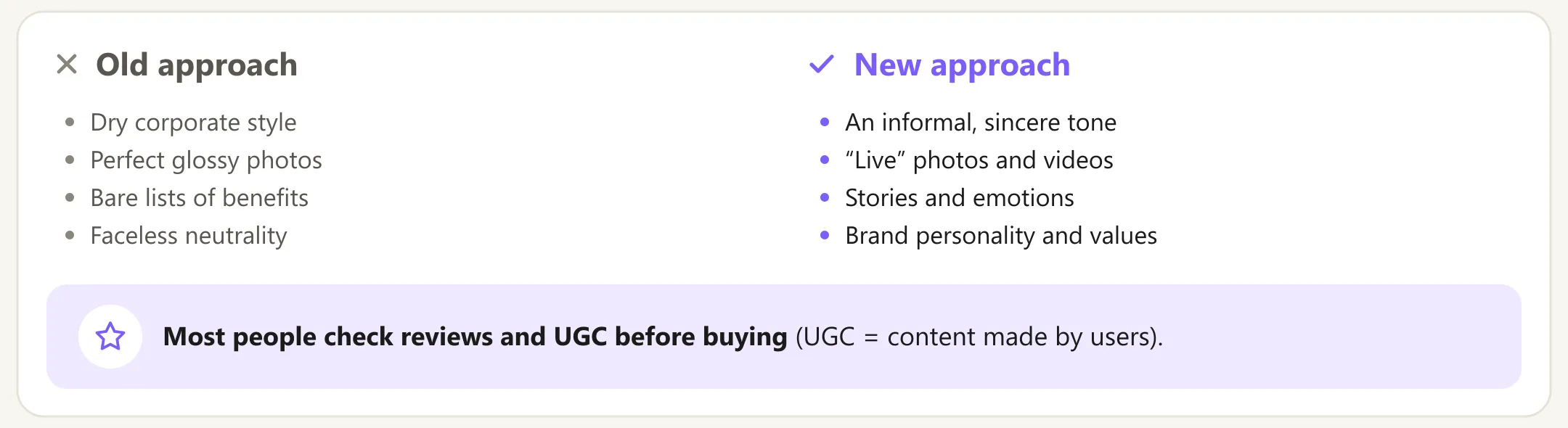
As for visuals: perfect glossy pictures are giving way to real photos and videos. People are more likely to believe a video review filmed on a smartphone than a professionally edited promo video. So aim for a balance of quality and sincerity: content should be technically decent (sound, light) but doesn’t have to be super-polished. And don’t forget personality: help the expert show their values and philosophy. Let them share their opinions, even somewhat controversial ones — this is better than faceless neutrality. On social media today, the brands that win are those that have become “real people” in the audience’s eyes.
4. Focus on engagement and community, not on chasing vanity metrics. A business may press its social media specialist: “Why aren’t our followers growing? Why so few likes?” Explain and shift the focus. 1,000 followers of whom 200 are actively engaged and turn into customers are better than 10,000 bots or off-target followers who bring nothing. Audience quality matters more than quantity. Track engagement metrics: ER (engagement rate), saves, shares, meaningful comments. Set KPIs for these figures, not only for follower growth. Talk to your audience regularly in the comments — ask questions in posts and encourage people to share their opinions. The more live dialogue, the stronger the community around the brand. If you see that a core of fans has formed, you can suggest that your client create a closed group or channel for them. This will bind them even more. Your task as a content marketer is to build community marketing. Here, followers create the buzz around the brand themselves (they talk to each other, help newcomers, create fan content). Suggest community activities to your clients: online challenges, contests, offline meetups, joint live streams with followers. Gradually the audience will stop being a faceless mass and become a club of like-minded people. And that is a direct path to loyalty and sales without resistance. Make this clear to the management: reach may dip for a while and algorithms may change. But if a brand has a loyal community, it will keep the content alive even when reach is low. People will visit the page themselves, ask about the new post and so on.
5. Use the power of collaborations and partnerships. In social media promotion, joint initiatives work well now. Look for collaboration opportunities for your client. These can be Instagram live streams with another expert from a related field, guest posts in a partner’s Telegram channel, or mutual mentions in newsletters. Such co-marketing brings in a new audience at minimal cost. Also think through an influencer marketing strategy (if it fits the topic). Choose micro-influencers whose audience matches your product’s target audience. Work with them on a mutually beneficial basis. This doesn’t have to mean big budgets — it can be barter (access to the course in exchange for a review in Stories) or affiliate links. In 2024 people trust recommendations from real people more than direct ads. So native collaborations are your tool. Also collect and present social proof: case studies, reviews, ratings. As a social media specialist, you can turn a review into an attractive post, an infographic or a short video — so it works as content. Plan a series such as “Our students about us” or “Your questions — our answers”. Publicly answering questions from the comments is also a kind of work with UGC. Another option: contests and challenges with prizes. For example, an online challenge for followers — film a video about what they learned, with a branded hashtag. The best get a prize (a free consultation, merch and so on). This generates lots of content and brings in new people through participants’ friends. In short, don’t run accounts in isolation — integrate the brand into the wider social media ecosystem through cooperation and content from the audience.
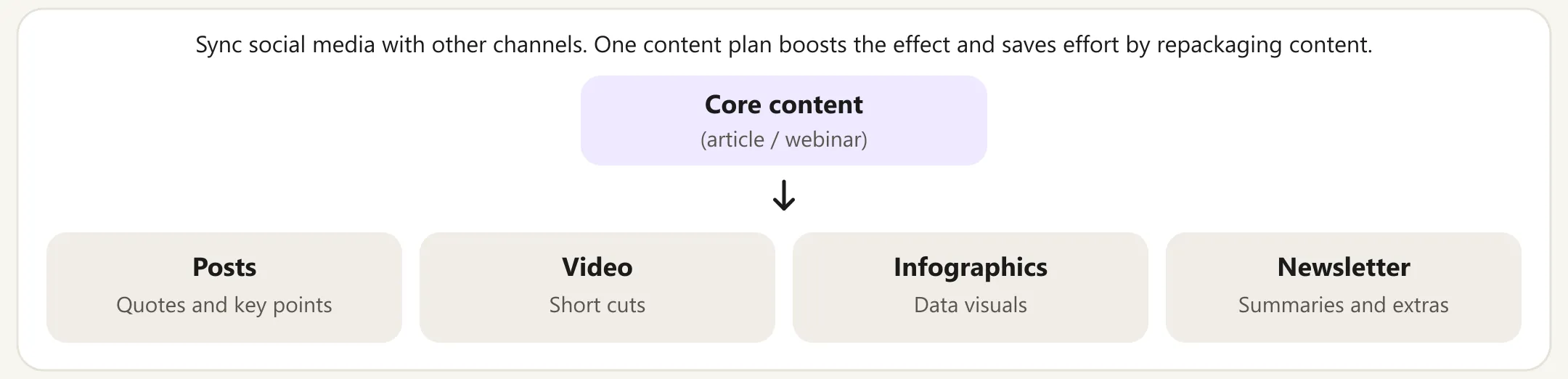
6. Support social media with other content marketing channels. A modern social media specialist’s role often goes beyond just “running social media”. Where possible, align your work with your client’s email marketing, blog and SEO. For example, if the expert publishes a new article, announce it on social media and pull interesting quotes from it for posts. And the other way round — a successful post that drew questions can become the basis of an email “You asked — we answer”. Such channel integration creates one brand voice and strengthens the effect. Also encourage the audience to move between platforms. In a YouTube video, invite people to follow the expert’s Instagram for behind-the-scenes content. In a LinkedIn post, offer a free PDF download (in exchange for an email). This flow of followers raises the chance of conversion on the channel where they prefer to consume content. Another aspect is SEO content. If your client has a website or blog, work together with a content marketer or take on this role yourself. Research your target audience’s search queries and prepare material that can go on the website and be reused on social media. For example, you made a big article “Top course business trends 2025”. From it you can create a series of infographics for Facebook, a thread on X, a short video summary. This way you make the most of every news hook. One content plan for all channels — that is what to aim for. It is consistent for the brand, and it saves you effort (you don’t invent something different for each channel from scratch; you adapt).
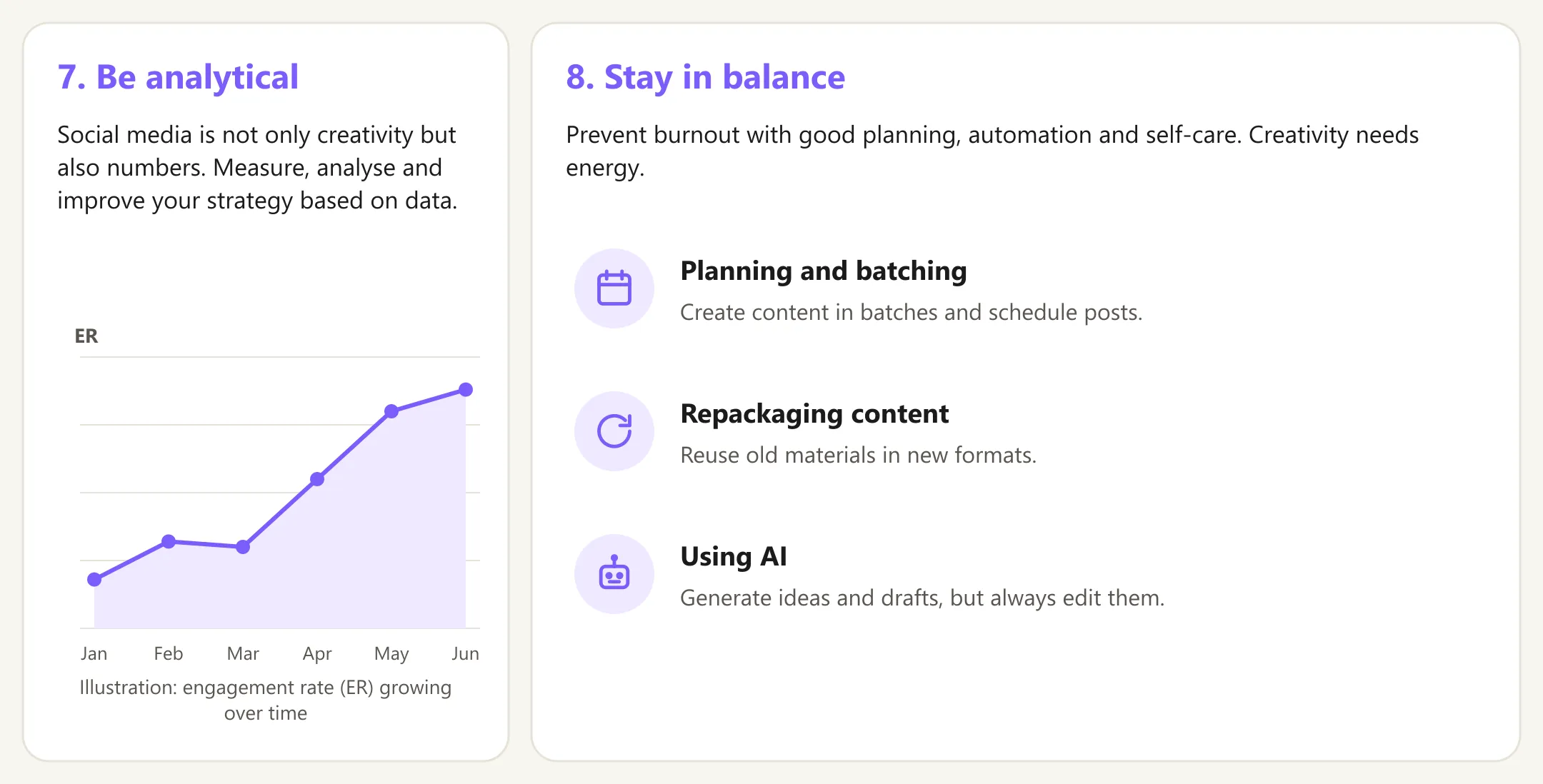
7. Don’t forget data and analytics — measure, analyse, improve. Social media is not only creativity but also numbers. Set up analytics for all channels. Track which posts get reach and engagement, what posting time is best, and where traffic to the website or webinars comes from. Google Analytics and UTM tags will help. Review results regularly: what worked this month and what didn’t. Run A/B tests on a small scale. Present the same material in different ways (for example, a video vs. a carousel of slides) and compare the response. Experiment with the first 2 seconds of a video or with different post headlines — sometimes a small change gives a jump in engagement. Pass all these insights on to your client and build them into the strategy. Also pay attention to web analytics of the customer journey. For example, you see that 100 people came from Instagram to the course landing page, but few bought. Perhaps the problem is not social media but the landing page — yet you noticed it and can suggest changes. Become not just a “content person” for your client but a strategic partner who sees the whole picture and suggests what to change. For example, if you see the audience responding less to the same kind of content, suggest a new format. Base it on analysis and cases showing why it should work. Use social media analytics tools: built-in ones (Meta Business Suite, TikTok Analytics) and external ones (for example, Sprout Social, Hootsuite reports) for clearer metrics. Track KPI changes month by month and adjust the goals. When organic reach is falling, growth in numbers may be small. Then show success in quality: “our engagement rate grew from 5% to 7%, people comment and discuss more — so trust is growing”. Clients love numbers, so give them the right numbers that reflect real progress.
8. Prevent your own burnout: optimise your work and look after your balance. A social media specialist’s job looks fun: just create posts. But in reality it means constant deadlines and multitasking, which can lead to burnout. To avoid burning out yourself (and losing effectiveness), introduce good time management and automation of routine tasks. Plan content ahead: make a content plan for the month and agree topics with the client in advance. Batching content is a great technique. Set aside 1–2 days a month just for creating content in bulk (write 10 posts at once, film a batch of videos in one go). Then use scheduling tools (Meta Business Suite, Buffer, Later and so on) so everything goes out automatically on schedule. This way you get rid of the feeling that “every day I have to come up with something”. Be sure to repurpose content: don’t hesitate to reuse material in different forms. For example, split a long video into 5 short ones for social media. Turn the expert’s answers in a webinar into a series of short tip posts. Update an old article and promote it again as current. This is not cutting corners but a sensible saving of effort. Most of your audience never saw the old posts. Those who did won’t mind a refresh (especially if you rework it a little). Another friend of the social media specialist is templates. Make templates for regular series (in design — in Canva/PSD; in text — wording for intros and endings). This will speed up production and reduce mental load.
Make more use of AI tools for social media. They can suggest post ideas on a topic, generate a draft text or a set of hashtags. This doesn’t mean blindly publishing what the AI gave you — but for inspiration and rough work, it helps a lot. The main thing is always to edit it into natural language and the brand’s tone. And finally, set personal boundaries: in social media it is easy to end up online 24/7, and you must avoid this. Agree reasonable expectations with your client. For example, agree that you don’t have to answer comments at night, or that you have days off with no posts. Learn to delegate or bring in help if the workload grows. It may make sense to split tasks (one person does the creative work, another replies to community messages). Don’t be afraid to speak up if there are too many tasks. It is better to honestly adjust the scope or increase the budget for an assistant than to try to carry everything and break down. Remember that creativity needs energy: to come up with interesting content, you need to get inspiration somewhere (from life, rest, learning). A tired, worn-out social media specialist can’t generate great ideas. So looking after yourself is part of the job. Plan breaks from social media, and alternate intense periods with pauses. After all, your productivity and health are also an asset for your client.
By following these tips, both course creators and promotion specialists will adapt more successfully to the new realities of 2024–2025. The main common denominator is a focus on people and value. Those who truly care about results for their students and build long-term relationships with them need not fear any algorithms or crises of trust. Online education is evolving towards quality, meaning and cooperation — and in the end this makes the industry better for everyone involved. May your content be meaningful, your marketing honest, and your customers satisfied and loyal!