
This article is not legal advice. Are your privacy policy, terms and conditions, cookie banner and similar pages done right? For a precise assessment of your risks, consult a legal professional in your jurisdiction.
Part 1. The classic mistakes many sites make
1. There is a cookie banner, but it does not meet EU law
This is the most common mistake: the site has a banner, but the wrong kind.
A study of the top 10,000 websites in 31 European countries looked at 254,148 websites (CHI 2025). It found that 67% of sites show a consent banner. But only 15% of those banners meet the minimum requirements. The main reason is that the banner has no “Reject” button.
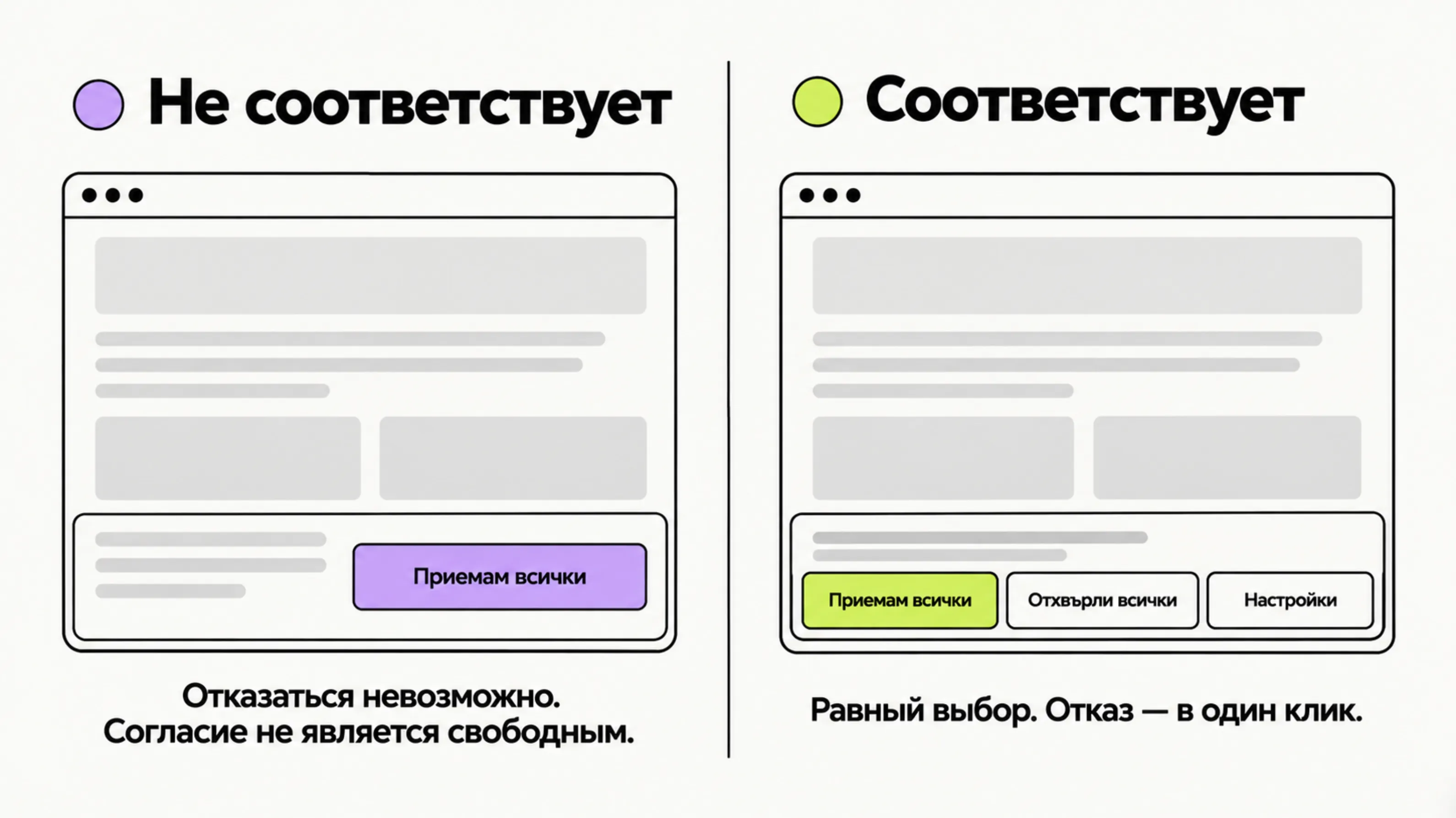
What makes a cookie banner invalid:
- there is no “Reject” button on the first screen, next to “Accept” and just as visible
- rejecting takes more clicks than accepting, or is harder to see (61% of EU sites)
- boxes are ticked in advance (the EU Court of Justice ruled in Planet49 that a pre-ticked box is not consent)
- wording like “by continuing to use this site, you agree” — passive consent does not count in the EU
- a cookie wall: “accept cookies or leave” — in most cases this is not allowed
2. Tracking starts before consent
The banner is showing, but Google Analytics and Meta Pixel have already run. Technically, this is the most common real leak.
The numbers: tracking before consent was found on 44% of EU sites and 68% of sites worldwide. On average, a site sets 16 cookies before the visitor has made any choice. On about 24% of sites (23% in the EU), tracking goes on even after the visitor clicks “Reject”. And 58% of those keep setting third-party cookies.
3. Third-party fonts, maps, CAPTCHAs and videos
Developers don’t add this on purpose, but themes and plugins bring it in.
When a page loads something from another company’s server, the visitor’s browser sends that server its IP address, user agent and the page address. An IP address is personal data. No cookies are needed for this: it is simply how HTTP works.
The precedent: on 20 January 2022, the Munich Regional Court ruled against a website owner (Landgericht München I, case 3 O 17493/20). The owner had to pay a visitor €100. The site loaded Google Fonts from Google’s servers and passed on the visitor’s IP address without consent. The court said there was no legal basis, because the fonts could be hosted on the site itself. The amount was small, but the effect of this precedent was not: a wave of letters swept Germany, demanding €100–170 per site.
Where this can come from without the owner knowing: WordPress themes, page builders (Elementor, Divi), plugins, embedded Google Maps, reCAPTCHA and YouTube embeds.
What to look for in the code: fonts.googleapis.com, fonts.gstatic.com, ajax.googleapis.com, maps.googleapis.com, reCAPTCHA, YouTube iframes.
How to fix it: host fonts and libraries on your own site. Load maps and videos only on click (click-to-load), and use at least youtube-nocookie for YouTube. Replace the CAPTCHA or load it only after consent.
4. The privacy policy is copied from the internet
Judging by European regulators’ decisions, this is one of the most common reasons for penalties. The site has a privacy policy, but it is copied from another site and does not match what the company really does. The real data controller is not named, or the wrong services are listed. There are no retention periods, no working company email for requests, and so on.
An honesty test: does your policy name the services your site really uses (booking platform, email service, pixel, analytics)? If not, it is not your policy.
5. A form with no consent and no link to the policy
Say your site has a booking form that collects a client’s name, email and phone number. If there is no checkbox and no link to the privacy policy next to it, you have a problem. You need a short notice by the form (who collects the data, why, and a link to the policy). If the legal basis is consent, you also need a checkbox that is NOT ticked in advance.
Also: consent to a service and consent to marketing emails are two separate consents. You cannot combine them in one checkbox.
6. No seller details
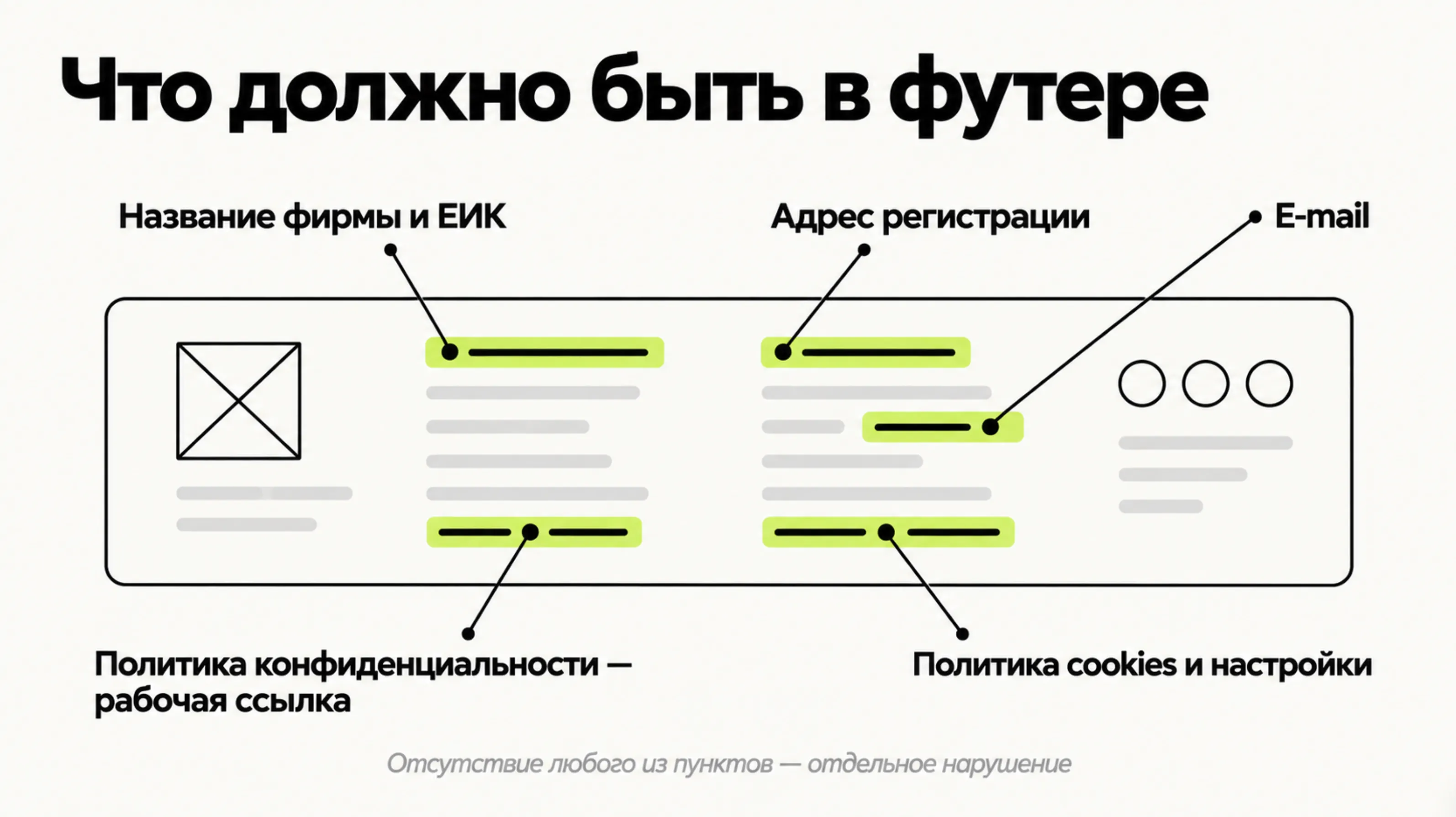
This is a requirement of the e-Commerce Directive (in Bulgaria, Art. 4 of the Electronic Commerce Act, ZET). The site must show the name of the company or sole trader and its registered address. It must also give contact details, including a phone number and an email. And it must give its registration details (for a company, the EIK, the Bulgarian company number). A phone number or WhatsApp does not replace the email — it is required. I checked a random sample of Bulgarian beauty websites: zero companies out of seven showed these details.
7. Invisible gaps that are not on the site, but can still lead to fines
Site owners usually know nothing about these, because they are really about documents, not the site:
- Records of processing activities (Art. 30 GDPR) — a written document that the regulator asks for first during an inspection
- A data processing agreement (DPA) with every contractor who sees your clients’ data: booking platform, website builder, email service, accountant, CRM
- Retention periods — for example, five-year-old enquiries sitting in your inbox and in the booking platform’s admin panel with no reason to keep them
- A data breach plan — you have 72 hours to notify the regulator, counted from the moment you learn that your clients’ data was compromised
8. Client photos and reviews
“Before and after” photos are the most sensitive and risky point, if we stay with the beauty sector. They show a specific person. In some cases (skin or hair condition, effects of an illness) they are also health data, which is a special category of personal data. You need separate written consent. It must say exactly where the images will appear (social media, the website, printed leaflets), and the person must be able to withdraw their consent.
Reviews copied from a messaging app with the person’s name and profile picture should, in principle, also be published only with the client’s permission.
Part 2. What has come into force recently — and almost nobody has heard of it
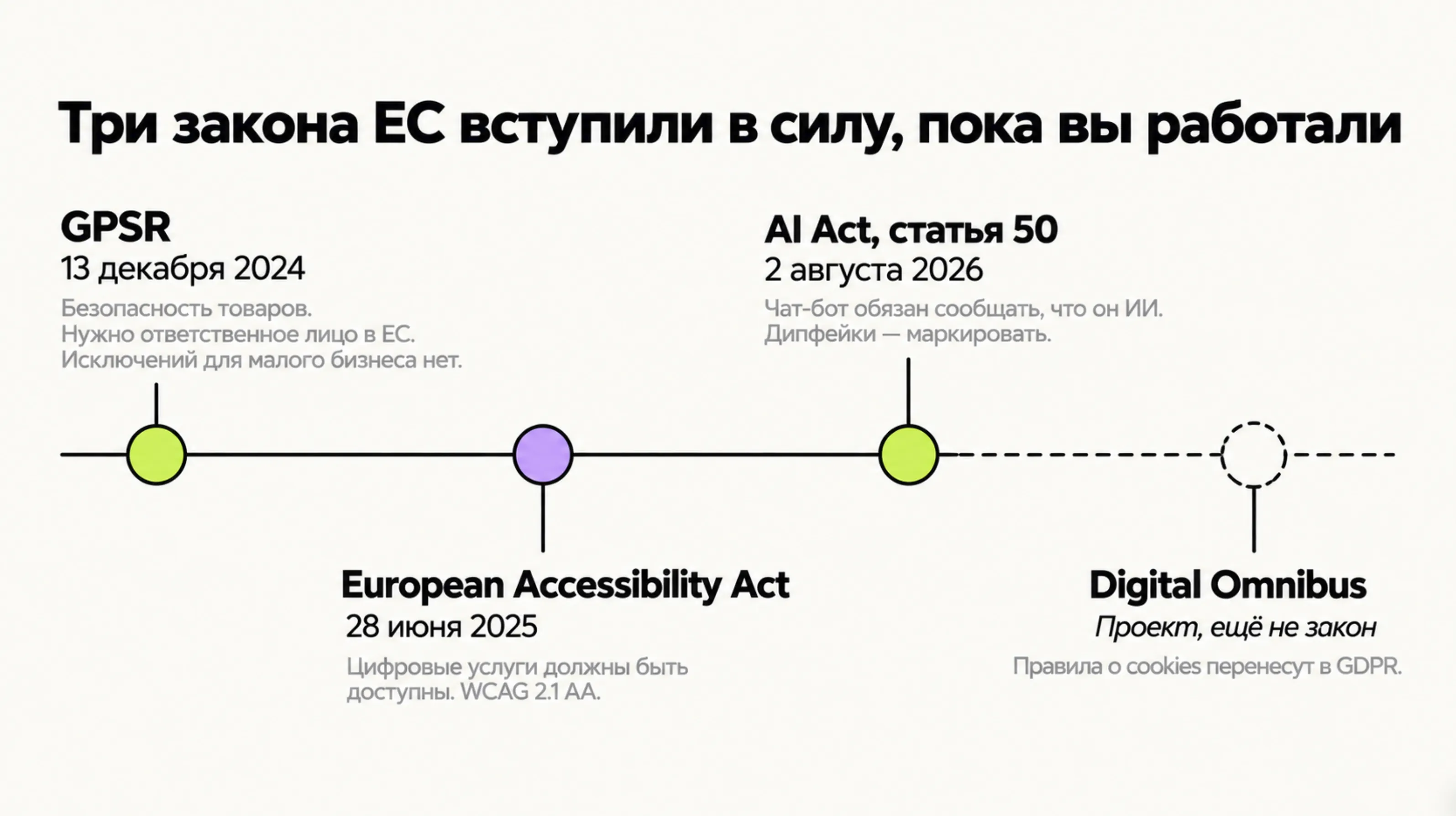
9. European Accessibility Act — since 28 June 2025
Directive (EU) 2019/882. It requires digital services for consumers to be accessible to people with disabilities. In practice this means WCAG 2.1 level AA, as in the EN 301 549 standard. The site must work with a keyboard, support screen readers and have enough contrast, and you need to publish an accessibility statement.
The “microenterprise” trap. There is an exemption, but it is narrow. It applies only if you have fewer than 10 employees and an annual turnover or balance sheet of no more than €2 million. Both conditions must be met. The exemption covers only services: if you make or sell products covered by the directive, it does not apply. Once you grow past the threshold, the exemption is gone at once, with no transition period.
Each country sets its own penalties. Fines can be charged for each breach, and some countries also allow daily penalty payments for an ongoing breach.
Services may keep using products that were already in use before 28 June 2025 until 28 June 2030. Service contracts agreed before that date may run unchanged until they end, but for no more than five years. Archived content not updated after 28 June 2025 is exempt from this directive.
10. AI Act, Article 50 — since 2 August 2026
It already applies. A chatbot MUST tell people that they are talking to AI. If you publish deepfakes or realistic synthetic images and videos, you MUST label them.
Important: some duties fall not on whoever builds the AI, but on whoever uses it. A business that publishes realistic AI-made images or videos MUST tell its audience. For a chatbot, the provider must build in the notice — so check that the bot on your site really says it is AI.
What does NOT need a label: ordinary marketing text that a person has edited, or routine photo retouching. But if AI changes a product so that it looks better than it really is, the image may count as a deepfake (AI Act, Art. 3(60)). Then it needs a label.
The maximum penalty: €15 million or 3% of worldwide annual turnover, whichever is higher. It applies wherever the business is registered — what matters is that its users are in the EU.
11. Omnibus: prices and reviews
Directive (EU) 2019/2161.
Discounts. When you announce a discount, you must show the previous price. That is the lowest price at which you sold the product in the last 30 days. You cannot calculate the discount from the manufacturer’s recommended price if you recently sold it for less. “Up to 50% off” with no basis is also a breach.
A recent example: in January 2026, the Polish regulator UOKiK fined Zalando and Temu almost PLN 37 million in total (about €8.8 million). The reason was how they calculated and showed the 30-day reference price.
Reviews. Fake reviews are banned outright. If you publish reviews, you need an internal process to check that they come from real clients, and you must say how you check. You don’t have to verify every client — the duty is to have such a process and describe it.
The maximum fine: for large cross-border cases, it must be at least 4% of annual turnover in the countries concerned.
12. GPSR — since 13 December 2024
Regulation (EU) 2023/988 on general product safety. It covers everyone who sells physical products to consumers in the EU — including through their own website, not only marketplaces.
What you need: every product must have a responsible person established in the EU. Their contact details must be visible in the online offer itself, not only in the documents. You also need technical documentation, a risk assessment and a procedure for reporting incidents.
There are no exemptions for small businesses or small volumes. This caught thousands of sellers off guard. Listings were taken down, and marketplaces started asking for documents.
A detail: GPSR does not cover what is regulated by sector law — cosmetics, for example, follow their own rules.
Part 3. What is changing right now
The Commission withdrew the long-stalled ePrivacy Regulation proposal. On 19 November 2025 it proposed the Digital Omnibus package, which moves the cookie rules straight into the GDPR as new Articles 88a and 88b. The proposal includes one-click refusal and a duty to respect signals set in the browser. After a refusal, a site may not ask again for six months.
An important caveat: this is still a proposal and has not become law.
Update, November 2026: on 21 October 2026 the Council agreed its position. It keeps the cookie rules in the ePrivacy Directive, cuts the no-re-asking period to four months and drops the browser-signal duty. The Parliament has not voted yet. The current framework is the GDPR plus the ePrivacy Directive, and that is what you must follow. But one thing is clear: a banner with no reject option is already a breach, and it will stay one.
Checklist: “check your site in 10 minutes”
Open your site in a private (incognito) browser window and go through the list:
- Did the cookie banner appear by itself, before any clicks?
- Does the banner have a “Reject” button on the same screen as “Accept”, and the same size?
- F12 → Application → Cookies: how many cookies are already set BEFORE you click anything?
- F12 → Network, filter by
google,facebook,gstatic: which requests went out before consent? - Ctrl+U and search for
fonts.googleapis.com— are fonts loaded from another company’s server? - Is there a clickable link to the privacy policy in the footer — and does it open?
- Does the policy name the services your site really uses?
- Under the booking form, is there a link to the policy and a checkbox that is not ticked in advance?
- Does the footer show the company name, EIK, registered address and email?
- Does the site work with a keyboard — does Tab reach every link and button, and can you see the focus?
- If you have a chatbot, does it say that it is AI?
- If you show discounts, is the previous price the lowest of the last 30 days?
- Do you have written consent from the people in your “before and after” photos?
Zero “yes” answers is normal for most sites. Three or four “yes” answers already put you above the EU average.
Sources
- A Cross-Country Analysis of GDPR Cookie Banners, CHI 2025 — arxiv.org/abs/2503.19655
- Landgericht München I, 3 O 17493/20 (Google Fonts, 20 January 2022)
- Directive (EU) 2019/882 — European Accessibility Act
- Regulation (EU) 2024/1689 — AI Act, Art. 50; European Commission guidelines of 20 July 2026
- Directive (EU) 2019/2161 — Omnibus
- Regulation (EU) 2023/988 — GPSR
- Digital Omnibus, European Commission proposal of 19 November 2025; Council of the EU press release of 21 October 2026 — consilium.europa.eu
- Annual report of the Bulgarian Commission for Personal Data Protection (CPDP) for 2025