A friend from Burgas came to me about her website. It was built by professionals, who took their fee. But they never warned the business owner that a website is not just a few nice pages of content. It also brings legal duties, and fines if it breaks EU and Bulgarian rules.
For example, on my friend’s site I found these serious breaches:
- The footer showed the words “Privacy policy”, but it was not a link, just text. Legally, this can count as misleading clients.
- There was no privacy policy page at
/policy(404), and the sitemap listed no policy page at all. - There was no cookie banner whatsoever.
Yet the site actively collects personal data. The home page has contact forms that ask people for their name, phone number and the service they want. Where does this data go, how is it stored, who is responsible for it? In short, regulators could have plenty of questions.
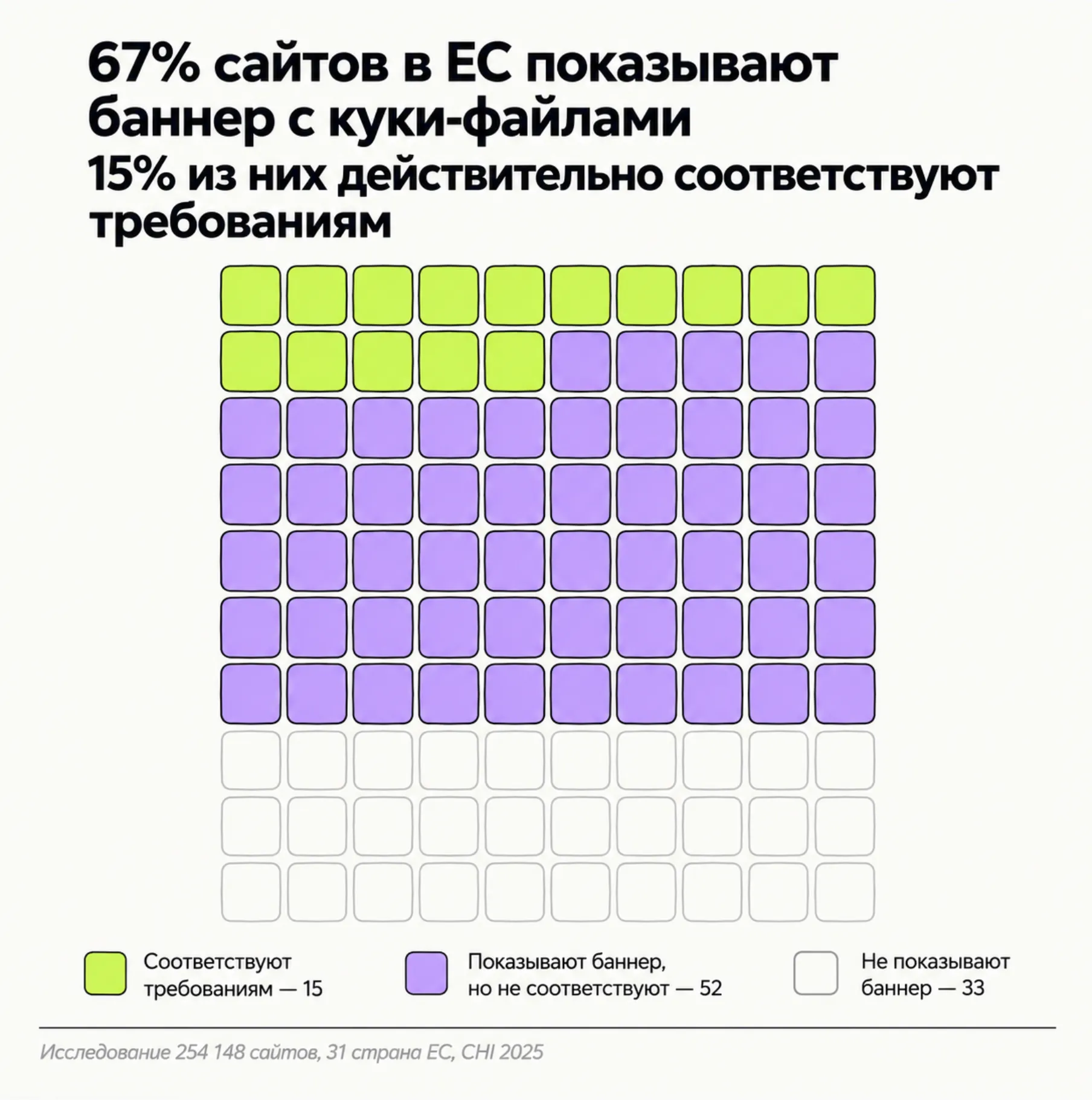
After putting together the final report for my friend, I looked at other websites in her line of work. The results are not encouraging. Seven out of 10 sites lack important elements and pages, which could lead to fines of up to several thousand euros. Only 1 site out of 10 was done properly and met EU law.
Which breaches appear on websites, and what they mean for business owners
1. Collecting data without informing people (Art. 13 GDPR) — the main breach. A person leaves their name and phone number but is told nothing. Who is the data controller (company, EIK — the Bulgarian company number, address)? On what legal basis, and for what purpose? How long is the data kept, who is it shared with (Tilda, WhatsApp/Meta), and what rights does the person have? There is also no consent checkbox with a link to the policy.
2. The words “Privacy policy” with no document behind them. This is bad in its own way: formally, it gives the impression that the document exists. In an inspection this is treated as misleading the consumer, not as a case of “we just forgot to add the page”.
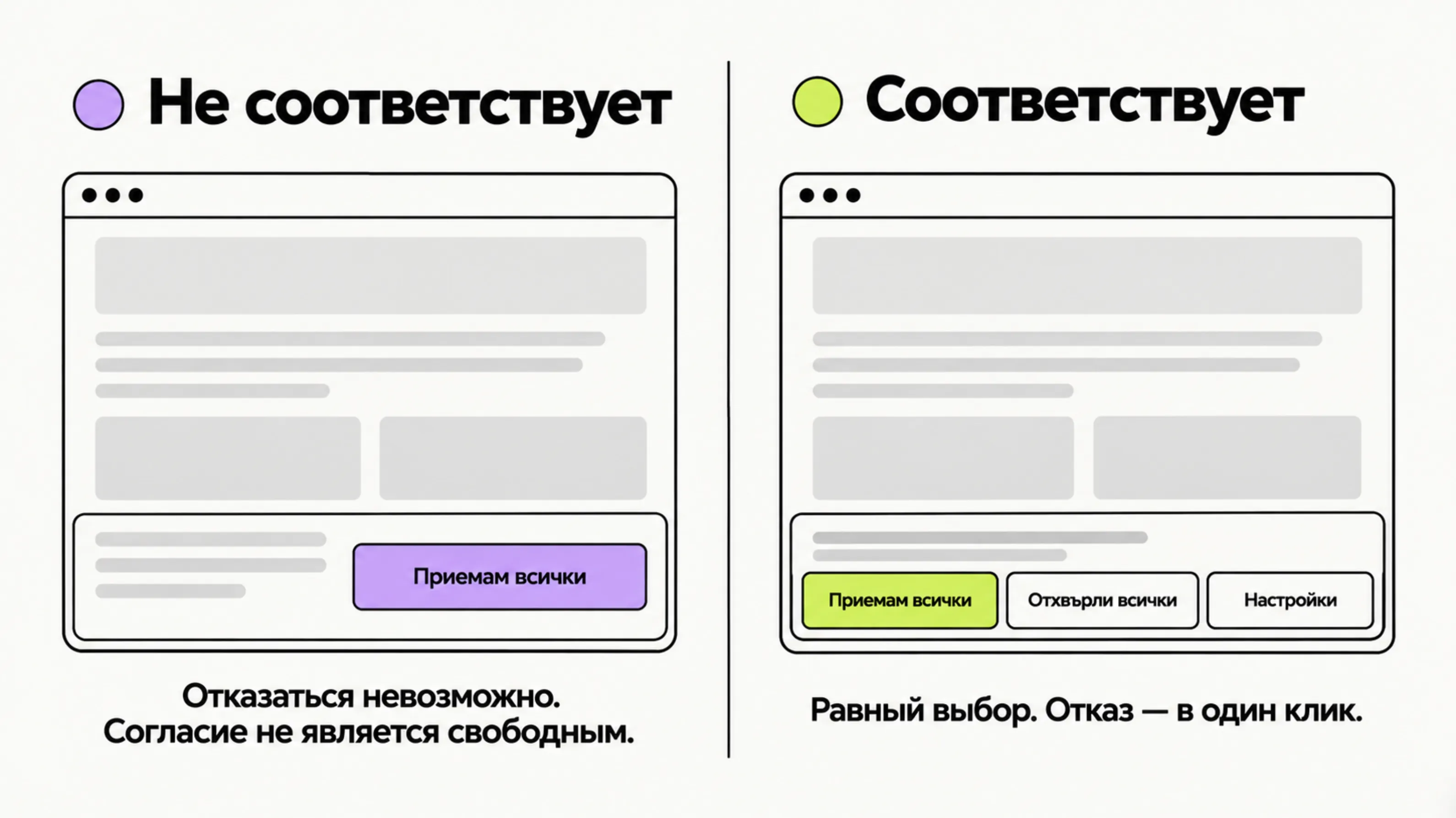
3. Cookies without consent. By default, Tilda sets its own identification and analytics cookies. If Meta Pixel or Google Analytics are connected, advertising cookies are added too. The rule comes from ePrivacy (in Bulgaria, Art. 4a of the Electronic Commerce Act, ZET) plus the GDPR. Any cookies that are not strictly necessary may be set only after explicit consent. Refusing must be as easy as agreeing. If the site has no banner, there is no consent at all. In my sample of Bulgarian sites, there was either no cookie banner at all, or the banner had only one button, “Agree”. Both are breaches.
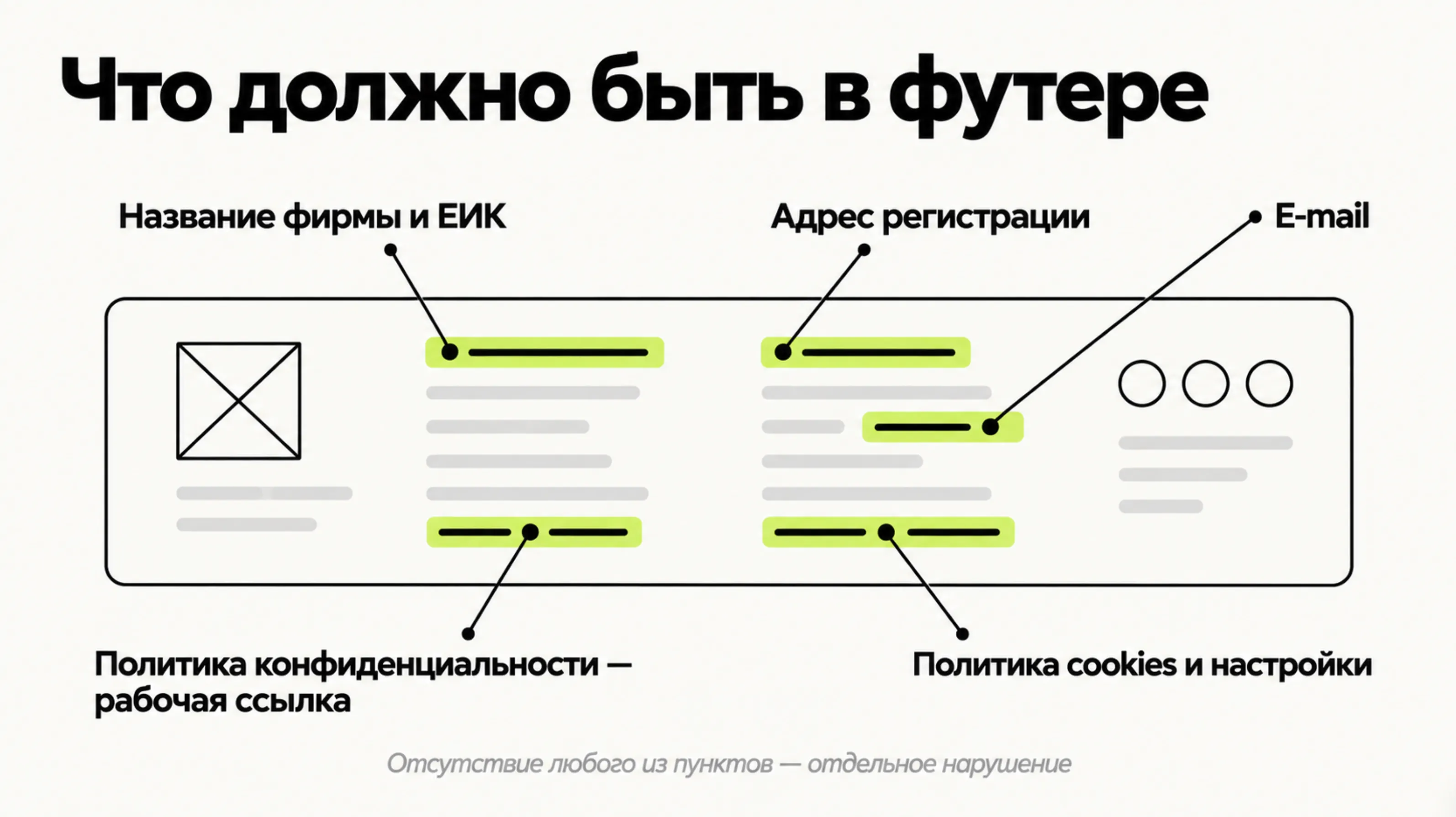
4. The trader is not identified (Art. 4 of the Electronic Commerce Act, ZET). The site shows no company or sole trader name, no EIK, no registered address and no email. Usually there is only a phone number and the physical address of the business. A company email is required on the site; in Bulgaria, the CPC (the Commission for Consumer Protection) checks this.
5. No terms and conditions. Say your site sells services, and clients book through WhatsApp, a contact form and so on. But there is no separate “Terms and conditions” page. Clients don’t know which offer they agree to when they pay. There is not a word about payment methods, cancellation, rescheduling or refunds. This is another serious breach of the law. For consumers, this is also the pre-contractual information required by the Consumer Protection Act (ZZP) for distance contracts.
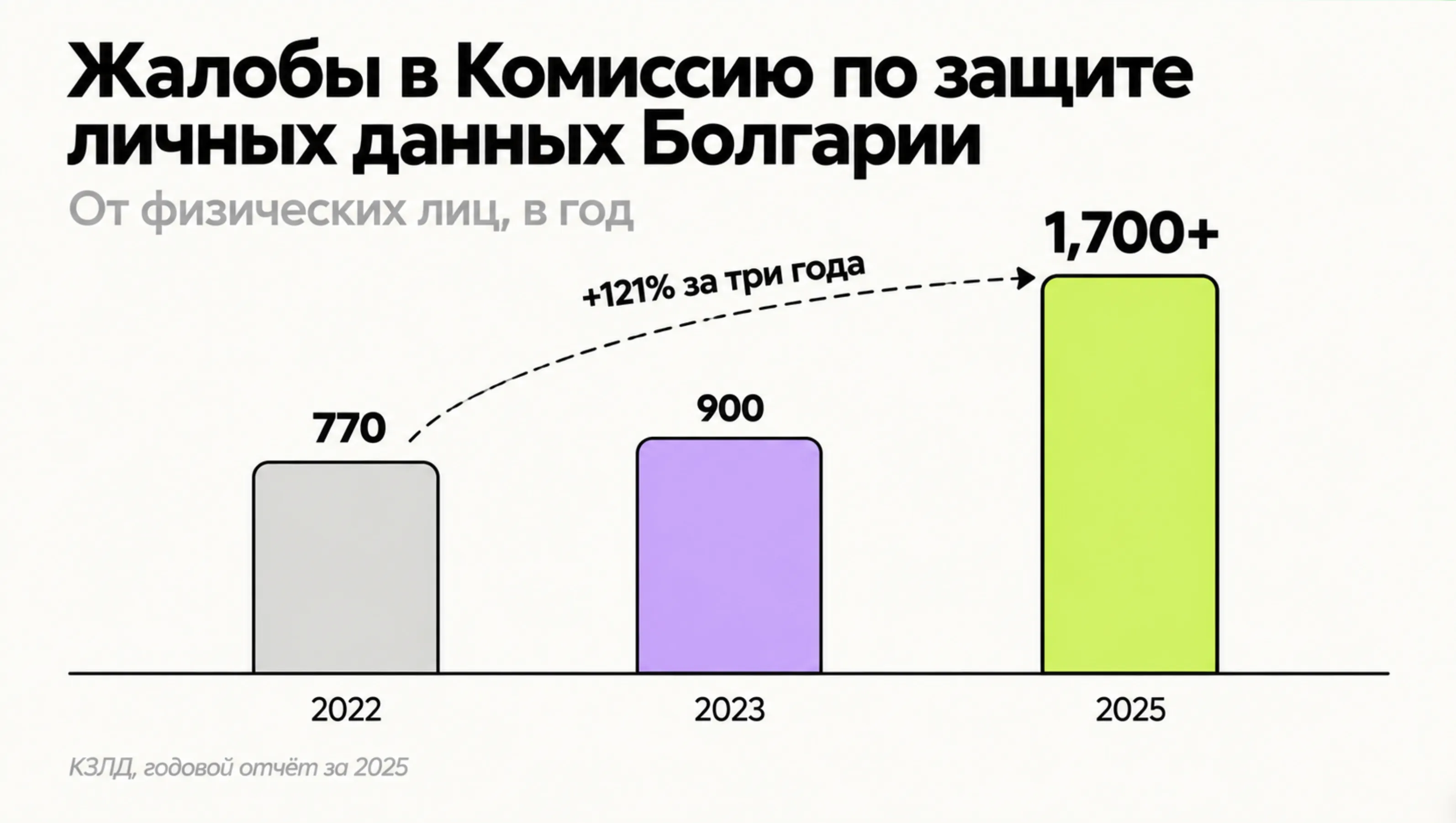
Bulgaria’s Commission for Personal Data Protection (CPDP) received more than 1,700 complaints from individuals in 2025. That compares with 900 in 2023 and 770 in 2022. This comes from its annual report (the full report is here: cpdp.bg, annual report 2025 (PDF)).
Or take the Spanish regulator, the AEPD, which publishes all its decisions, showing when business owners were fined and for what:
- Amor Ideal — a €600 fine for an incomplete privacy policy. It started with a complaint from a client who bought “love coaching” services. He was given no information about how his personal data was processed. At the time, the company’s website had no privacy policy with the controller’s details and users’ rights at all. Lawwwing
- Trueba Sport — a €1,200 fine for two breaches. It emailed more than 300 people without hiding their addresses, and it did not identify the data controller or link to a privacy policy. Lawwwing
- A website fined €10,000 in total. It paid €5,000 under Art. 13 GDPR for naming the wrong controller in its privacy policy, and €5,000 for analytics cookies set without consent. It also had no legal notice and no cookie policy. Adaptacion-rgpd
- For contrast, some large companies: Techpump Solutions S.L. — €90,000 for repeated cookie breaches on three websites. And Iberia — €30,000 for a badly configured banner. A user complained that she was forced to accept cookies to keep using the site and buy a ticket. Blog PSN Sercon, SoftwareLOPD
What penalties different breaches on a website can bring
The CPDP (personal data) — the main risk
The formal ceiling is high. As the supervisory authority, the CPDP can impose fines of up to €20 million or 4% of global annual turnover, whichever is higher. This covers processing with no legal basis and without informing people, and cookies without consent.
And there is no separate lower scale of fines for micro-businesses: the same rules apply to a small salon as to a large company.
Besides the fine, there are related problems:
- An order to stop processing. This means turning off the forms on your site, which cuts off your enquiries.
- CPDP decisions are public.
- An inspection starts after a complaint from a client, a student or a competitor. In the beauty sector, such inspections are common in Bulgaria. It can also start on the commission’s own initiative, planned or unplanned, without a complaint. (Source: the Bulgarian law firm Pravatami.)
- Separately, an unhappy client can claim compensation under Art. 82 GDPR. For example, this can happen if you collected their data and did not delete it when first asked.
The CPC (Electronic Commerce Act) — missing company details
Here the fines are specific, and you are more likely to get one. For breaching Art. 4 of the Electronic Commerce Act, an individual pays a fine of about €102 to €511. A company or sole trader pays a penalty of about €256 to €1,278. For a repeat breach, the fine is about €256 to €767 and the penalty about €511 to €2,045. The law still states these amounts in leva; I converted them at 1.95583 — Art. 23 ZET (in Bulgarian)
A practical risk people usually forget
Meta and Google require a working link to a privacy policy for ad accounts, and especially for lead forms. Without it, your ads may be rejected and your account restricted.
An honest view of the odds
No inspector will turn up at a beauty salon in Burgas or Sofia tomorrow “on their own initiative” — the CPDP’s resources are limited. The real scenario is usually this: an unhappy client or student files a complaint with the CPDP or the CPC. Often it follows a dispute over refunding an advance payment for a course, or over the result of a treatment. A complaint is free and can be filed electronically. And that is when everything missing from your site turns from an abstract risk into an official breach report and a fine.
Checklist: “check your site in 10 minutes”
Open your site in a private (incognito) browser window and go through the list:
- Did the cookie banner appear by itself, before any clicks?
- Does the banner have a “Reject” button on the same screen as “Accept”, and the same size?
- F12 → Application → Cookies: how many cookies are already set BEFORE you click anything?
- F12 → Network, filter by
google,facebook,gstatic: which requests went out before consent? - Ctrl+U and search for
fonts.googleapis.com— are fonts loaded from another company’s server? - Is there a clickable link to the privacy policy in the footer — and does it open?
- Does the policy name the services your site really uses?
- Under the booking form, is there a link to the policy and a checkbox that is not ticked in advance?
- Does the footer show the company name, EIK, registered address and email?
- Does the site work with a keyboard — does Tab reach every link and button, and can you see the focus?
- If you have a chatbot, does it say that it is AI?
- If you show discounts, is the previous price the lowest of the last 30 days?
Zero “yes” answers is normal for most sites. Three or four “yes” answers already put you above the EU average.
Sources
- A Cross-Country Analysis of GDPR Cookie Banners, CHI 2025 — arxiv.org/abs/2503.19655
- Landgericht München I, 3 O 17493/20 (Google Fonts, 20 January 2022)
- Directive (EU) 2019/882 — European Accessibility Act
- Regulation (EU) 2024/1689 — AI Act, Art. 50; European Commission guidelines of 20 July 2026
- Directive (EU) 2019/2161 — Omnibus
- Electronic Commerce Act of Bulgaria (Art. 4, 4a, 23–25), in Bulgarian
- GDPR fines in Bulgaria — CPDP practice (in Bulgarian)
- Terms and conditions for a website and online shop — CPDP supervision (in Bulgarian)
- End of dual price display from 9 August 2026 (in Bulgarian)
- CPC — questions and answers about the euro (in Bulgarian)